



Featuring selected outputs from last year’s KLFI Art Criticism Writing Workshop, we present this critique by Frankie Locsin on the group exhibition “Kung Iga na ang Bukal” at Gravity Art Space from August 15 to September 12, 2025. The exhibit featured works by Aaron Bonete, Amae Paruan, Elvira Bvlgari, Dae Tolentino, and Inang Dolorosa.
Frankie Locsin is a writer and cultural worker based in Metro Manila. In 2022, she was shortlisted for the Ateneo Art Awards – Purita Kalaw-Ledesma Prizes in Art Criticism.
The Path of Sacred Waters: Kung Iga na ang Bukal and Mount Banahaw
by Frankie Locsin
Mount Banahaw, the tallest mountain in the Calabarzon region, has a mystical reputation. Religious rituals have been recorded on the mountain as early as the 17th century. Even today, pilgrims hike towards its sacred shrines during Holy Week to request healing or other blessings. Devotees continue to bathe in its natural springs to symbolize the cleansing of sins. Locals offer prayers to appease the supernatural creatures that they believe reside there.
However, it isn’t merely spiritual. In the modern day, Mount Banahaw is also a popular spot for hikers and tourists. It is part of the Makiling-Banahaw Watershed, a government-owned water reserve that provides water to nearby localities, industries, and steam for power generation.
The exhibition Kung Iga na ang Bukal, held at Gravity Art Space from August 15 – September 12, 2025, explored the complexities of Mount Banahaw’s reputation. Five artists used mixed media works to discuss how the locals who live near Mount Banahaw relate to and see the mountain: as a divine being, as a contested ground, and as a sacred commons.
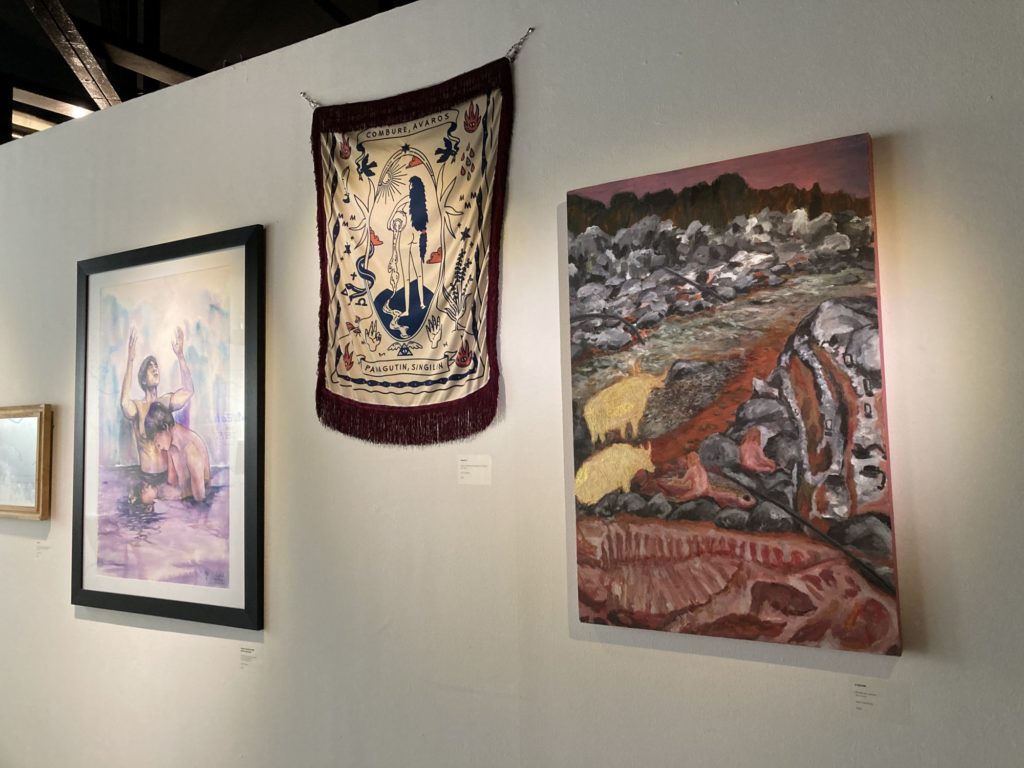
From left to right: Return to the Spring/Back in My Body by Aaron Banete. Source by Elvira Bvlgari. Lagnas by Dae Tolentino.
Mount Banahaw’s divine image is familiar even to non-locals, and it was most obvious in the works displayed. Return to the Spring/Back in My Body by Aaron Banete was a watercolor painting that depicted three men, each with the same face, participating in a river baptism, which references the real life practice of pilgrims bathing in the holy waters. Perhaps the triplets represented the Holy Trinity, as many sacred sites in Mount Banahaw also have biblical names or references. In Elvira Bvlgari’s Source, a fringed tapestry depicted a water-bearing woman standing atop a mountain. She was surrounded by various occult symbols—Christian, Jewish, and pagan alike—while the words COMBURE, AVAROS [To burn up, miserly] and PANAGUTIN, SINGILIN were written on the top and bottom of the image. The woman brought to mind personified deities of local mountains, such as Maria Makiling. Her water jar referenced Mount Banahaw’s role as a water source. In fact, locals also refer to the mountain as “Vulcan de Aqua” due to its various bodies of water. The combination of Abrahamic and pagan symbolism such as crosses, doves, and an all-seeing eye matches the eclectic nature of Filipino belief; locals often combine Catholic faith with folk religion.
Meanwhile, its waters are a sacred commons—used both for ritual and in a practical sense, for households and agriculture. At the entrance of the gallery space was Thirst Trap by Inang Dolorosa, an installation of two refillable drinking water containers which contained the natural spring water from Marcos Tigla Park. Present Memorial Vessels featured looping videos of Philippine lakes, rivers, and faucets overlaid on a wall where dozens of empty single-use plastic water bottles were attached. These two installations showed how the “holy waters” of Mount Banahaw were used for the locals’ everyday and secular needs. If they weren’t included in the exhibition and explicitly labeled, then one wouldn’t be able to distinguish them from any other water source.
Lastly, the exhibition text mentioned that Mount Banahaw is a contested ground. This could have been seen in two works. First, the painting Lagnas by Dae Tolentino depicted a rocky, polluted river. Dead fish and indistinct viscera flowed along red waters, while red-skinned people and yellow carabao sat by the shore. As tourism and industry pollute Mount Banahaw’s waters, the locals and wildlife suffer.
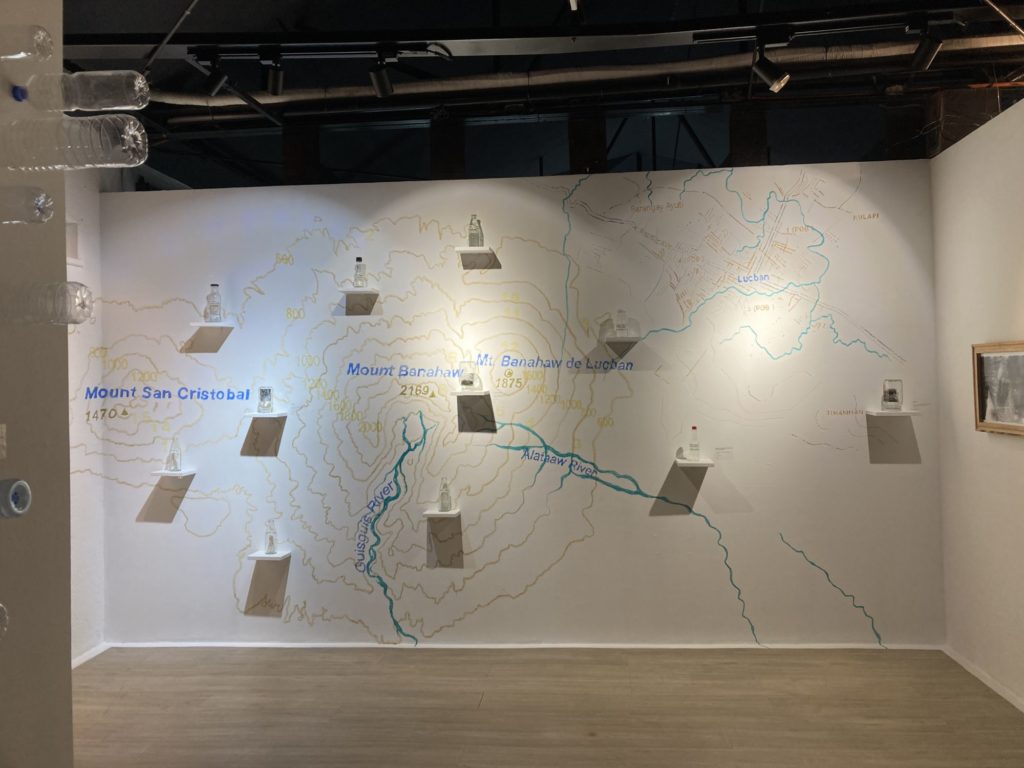
Pag-igib sa Sampung Paanan ng Bundok Banahaw by Inang Dolorosa.
Most intriguing was the largest installation: Pag-igib sa Sampung Paanan ng Bundok Banahaw, also by Inang Dolorosa. A giant topographical map of Mount Banahaw’s peaks, rivers, and the nearby residential barangays was painted onto the wall. Repurposed glass bottles were placed at certain points on the map. Some of them were filled with water from specific towns and labeled with their location and date of collection. Others contained monochrome photographs of the mountainous landscape and farmers. The installation acted as a small-scale reproduction of Mount Banahaw, representing not the mountain but rather its waterways borne from the water reservoir, and how they lead to local households.
When taken together, the artworks clearly express how Mount Banahaw is seen as a divine being, a sacred commons, and a contested ground by the locals. However, there is a neutrality to the tone that feels strange, especially when the exhibition text points out that the artists interacted with farmers, healers, and mothers who lived near Banahaw. With the exception of Lagnas, a painting that explicitly condemns water pollution, the rest of the works feel documentary and matter-of-fact. Yes, Filipinos continue to believe, four centuries on, that Mount Banahaw is a sacred place. Yes, Mount Banahaw has been converted into a water reservoir that funnels water to the nearby localities. But what then?
Two more photographs hung between the topographical map and the watercolor painting by Aaron Banete. Ritual and Keen by Amae Paruan were blurry photographs of an elderly man’s hand and an elderly woman’s side profile, but the papers were aged to make the images almost indistinct. It is unclear who they represent—local farmers, perhaps? But what are they doing, and what is their relationship with the mountain? The blurriness of the image matches the blurriness of its message. It captures a community that is far away from the Manila center, that has its own unique culture, and makes no other statement. The exhibition as a whole feels this way.
It is especially jarring because half of the works make use of photography, video, and found object installation. While those mediums can obviously be manipulated and do not always represent reality, the specific works project a sense of realism. They imply that these are real people and household items from Mount Banahaw. These are images of the rice fields, lakes, farmers, and these are refillable water containers and glass jars that Banahaw residents could own. However, they are all ordinary; without the captions, one would easily mistake them for items from anywhere else in the Philippines. The artworks that more obviously refer to Banahaw are fictionalized representations: a watercolor painting of a baptism, a metaphorical painting of water pollution, a hand-sewn tapestry of a divine being. If the artists had personally spoken to the locals, then could they not have incorporated photo or video documentation of real rituals, or perhaps of farmers’ struggles with the reservoir?
Even the intent of Present Memorial Vessels feels unclear. Perhaps the “memorial vessels” refer to the single-use plastic drinking bottles. But is it making a statement about environmental pollution? Or perhaps about lack of access to potable drinking water? The videos do not offer additional insights, as they only show the fact that Banahaw has abundant water resources, without showing the complexities of the residents’ relationship to the water.
The exhibition text does a lot of heavy lifting for the viewer. It ends with:
“Each work in this exhibition testifies to the interconnectedness of our stories in the same way that the river streams are connected to the mountains. Every piece is an urgent plea to act and resist, begging to ask: What remains of us when the vessel runs dry?”
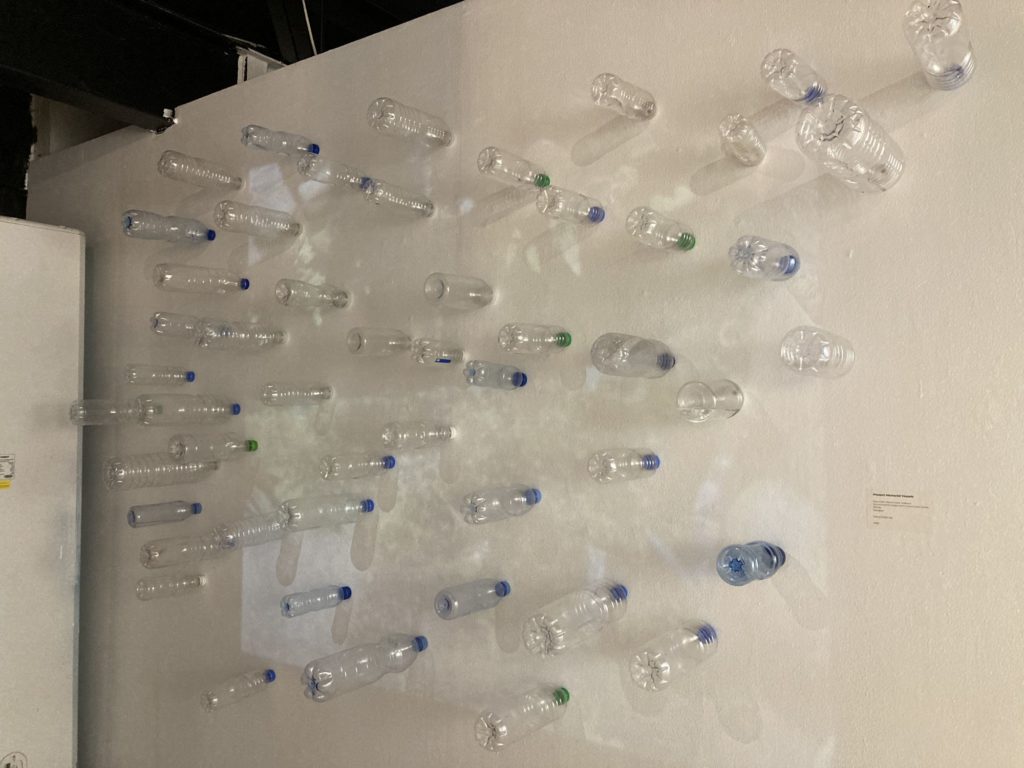
Present Memorial Vessels by Inang Dolorosa.
However, not every piece is an urgent plea to act and resist. Only Lagnas has made a strong position; the artist clearly disapproves of environmental pollution. The rest of the works act more like documentation of what exists, without making any explicit statements on how the artists or the residents feel. Even Pag-igib sa Sampung Paanan ng Bundok Banahaw, the most ambitious work in the exhibition, lacks additional context outside of how the waterways of Banahaw flow from the reservoirs towards farmers. Is it merely a topographical survey? Or is it making a statement on land access? This is one case wherein the work could have benefited from an extended caption or additional text that explained the author’s experience collecting water from certain sites and photographing the people who lived there. It also makes one wonder if the artist was a silent camera who simply collected water and photographic samples, or if they interacted with the residents at all on a deeper level.
Kung Iga na ang Bukal was an ambitious exhibition that tried to capture the complexities of one of the Philippines’ most iconic and historical mountains. However, while the works were interesting on their own, they lacked the cohesive drive that the curatorial brief promised. In some ways, the text felt like an over-reading of the works themselves. It is unclear which came first—the curatorial concept or the artworks. Regardless, it is a case where too much detail in the exhibition text took away from the strength of the exhibition, due to the disconnect between theory and what was actually on display.
Disclaimer: The views expressed in this critique are solely those of the author and do not necessarily reflect the views of the Kalaw-Ledesma Foundation, Inc. (KLFI).
Images accompanying this critique sourced by the author are used here for educational purposes only. KLFI does not claim ownership of these images, all rights remain with their respective owners.