




Featuring selected outputs from last year’s KLFI Art Criticism Writing Workshop, we present this critique by Red Sales on Derek Tumala’s “Phantom Limb” exhibited at Tarzeer Pictures from September 11 to October 30, 2025.
Red Sales is a writer & artist from Las Piñas. His art criticism and art practice gravitate towards the moving image. Red currently works as a college instructor and an architectural designer.
Shots in the Dark: Fragments of the Ecological Conversation in Derek Tumala’s Phantom Limb
by Red Sales
VOID
It’s 535 AD. You are in the depths of the ocean. It would be pitch black if not for the communication of bioluminescent sea creatures, some species of which have survived multiple mass extinction events. A volcanic winter is about to plunge the rest of the world into darkness.
It’s 50065 AD. You are in outer space. Neither the earth nor the sun can be found. Only the travelling glimmer from long-dead stars offers you any point of reference. Despite their light-years of distance from each other, you still form constellations.
It’s 2025 AD. You are in a dark room. Light only comes from screens of various sizes, glowing from disparate locations across an exhibition space. There’s an orange sun revolving nearby, a tiny fish in the distance, and beside it, a large skull with its skin crawling. There’s more happening in the other room. That’s where the music and thunder are coming from. Before following the faint blue light emanating from the back, you check the door behind you. It reads “PHANTOM LIMB” and “DEREK TUMALA”.
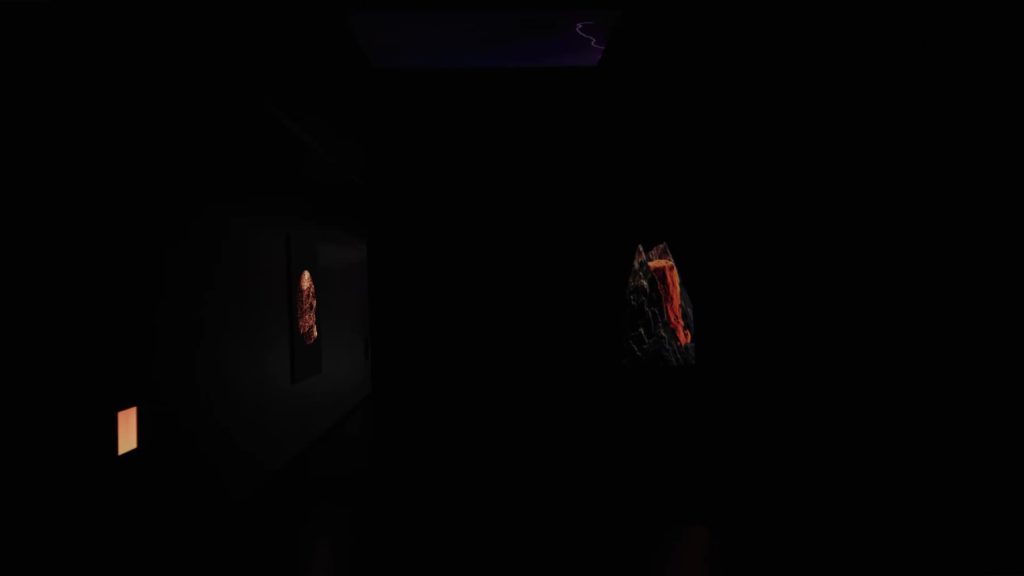
Phantom Limb exhibition view. Image courtesy of Tarzeer Pictures.
SPACE
The natural environment is everywhere in Derek Tumala’s body of work. The subject matter contrasts nicely with his new media experimentations of digital video, interactive installation, and live performance. Phantom Limb steps foot in this direction. It is a scattered collection of 11 screen installations that display looping videos of a wide array of subjects. There’s ambiguity inherent in its selection and presentation of video subjects. Science and art blur together in this conversation of ecology. Its design raises questions of how to mediate dialogue. Our relationship to visual media is constantly shifting, while only becoming more extensive. The ecological crisis has similarly accelerated past the state of irreversible catastrophe. We’re still in the dark in terms of dealing with any of this.
The fundamental absence of light in the exhibit allows melancholic music and the scent of burnt incense to prepare a solemn meditation on loss and regeneration. Vision winds down for more senses to flourish. Nevertheless, our eyes can’t help but gravitate towards the glowing screens as our only source of light. Pieces of varying size float high and low as they beckon from far off into the distance. Their subjects revolve around the convergence of the natural and artificial, as well as the cycles of creation and destruction. These images converse with each other from across the room in connections guided by our imagination. This is a space of reflection.
CYCLES
No single piece in the exhibit exemplifies these connective cycles better than the one closest to the entrance, entitled “Cycling Through the Purity of Tensions”. It’s a circular screen that displays circular subjects. Similar in size and placement to an exhaust fan, it actually presented itself as one when I first walked in. The image then turned into many different things, distinguishing itself from the rest of the video works by its use of montage. This work was flowing through imagery of a crater, an eyeball, a ring of fire, a whirlpool, warp-drive travel, the eye of a storm, and more. Primordial and futuristic imagery blend as the underlying tension between nature and technology manifests with a red-tinted intensity. The fan, now as part of the video loop’s grander scheme, became a paradox. We use them to cool our surroundings while ultimately contributing to warming up the planet. The circular screen has become a perfectly eclipsed Venn diagram of natural disasters, human interventions, and cosmic scales.
At the end of the hall is another video of a sun, “It Gets Colder When You Stare At It”. This is the one emitting a sharp blue light that compliments or rivals the orange hue of the sun at the front. It glows in the background, keeping at the back of our minds the suggestion of parallel worlds out there that may contain inversions of the nature we claim to know.
It’s 2024. Derek Tumala introduces “a warm orange coloured liquid” at Ayala Triangle Park. It’s a public installation that features a six-meter-tall orange sphere and shifts perspectives on sustainable development, presenting a solar-powered sun. It’s a completely different approach from the expansion of perspective and scale in Phantom Limb, which is done through its video editing and installation within a network of video channels.
The orange sun of Phantom Limb slows down and is overtaken by a continuing cycle of destructive imagery. Crawling ants are superimposed over the sun, as if it were a carcass. The idea is more overtly committed in the largest piece displayed, “Your Mortal Coil”. Here lies a skull formed by a swarm of insects, offering a visceral reminder of a fundamental concept in ecology;
that life sprouts from death.
CATACLYSMS
The other large screens spell out death through natural disasters: the volcano and the storm. Both pieces fill the exhibit with their sound. The volcano screen, “Your Rupture, My Desire,” is the source of the exhibit’s forlorn tune. It depicts an eruption while embracing artifice in its rendering of imprecise models, muted colors, and generated textures. The storm screen, “Celestial Cannon: Spectre Mills,” rages on with an actual audio-video recording of a thunderstorm playing on the ceiling. Its countless vivid flashes of lightning in dark clouds make it a miraculous sight to stare up at directly without risking our safety. Both forms of simulated calamity will only become more devastating and more frequent the longer that people disregard ecological balance.
DOOMSDAY
It’s 2011. An earthquake, a tsunami, and a nuclear disaster have killed over 20,000 people in Fukushima, Japan. In 2009 – 2010, over a dozen oarfish were found washed up on the country’s coastline. This reinforced the myth of the oarfish being an omen for impending disasters, a storied history that has earned it the name “doomsday fish.”
Near the floor of Phantom Limb, a piece titled “Silverlight, It’s Not Your Doom” depicts a barely-moving, alien-like doomsday fish that actually does come with a looming threat of calamity. Across the room is a comet displayed in a similar size and composition to the fish. This video is titled “Come to Me, Dear Light, Alas! I’m Alive.” The comet’s steady movement radiated an inevitability to its doom. Yet the Japanese folk legend of the doomsday fish was constructed out of coincidental proximity. Science has proven no direct causal relationships between the fish and the doom that follows. Perhaps I’ve also assumed the correlation between these two videos out of the same impulse to connect.
The formal similarities make it more organic to find conceptual parallels between these two videos than most other possible pairs in the exhibition. The depths of the deep sea flow right into the vacuum of deep space, especially through the designed void of the exhibit. These are uncharted frontiers that inspire the imagination. They are otherworldly spaces that have remained even after the Earth’s many cataclysms.
LOSS
The exhibition can be seen as the ruins left of what was once a complete film, now almost entirely disintegrated after a cataclysmic event. What it lacks in conventional storytelling material, such as cohesive plot structures, main characters, and narrative continuity, viewers have to make up for with speculation. You can make connections between videos with similar shapes, sizes, and subjects, pairing them like limbs. Even in its choice to avoid the typical round numbers of 10 or 12, the exhibition leaves room to welcome conceptual gaps and offshoots that are ideal for our minds, which are naturally inclined to fill in the blanks.
A “Phantom limb” refers to a phenomenon of the brain interpreting sensation from a body part that is no longer there. It has to do with the idea of muscle memory, our body’s ability to perform without conscious thought, stemming from familiarity.
DOOMSCROLL
Rather than seeing deconstructed film ruins, we may be familiar with engaging with fragmented videos through the act of doomscrolling. Derek Tumala has worked with the idea before in his exhibition “winter high through the veins in search of hot weather,” where they explore this fascination with doomscrolling as a virtual world of escape. The cycles of euphoria and depression manifest in the juxtaposition of the internet’s disparate imagery, such as genocide and lunch.
The series of videos in Phantom Limb could be seen as an Anti-doomscroll. Videos come in a similar form of fragmented short loops, but they wholly reject online platforms’ slant towards passive consumption, overstimulation, explanation, speed, and algorithmic curation. There’s a notable difference between the unintentional montage of scrolling from one random reel to another and a designed fragmentation of videos with obscured intentions.
CONVERSATION
Being left in the dark here isn’t merely about intentions or symbolism. It becomes practically impossible to read any additional information inside the exhibit. The only readable text is in the work “My Darling, It’s Siracusa,” as silent subtitles over ocean waves. The lines mention the need to talk, and to invent something to talk about when there isn’t anything to say. It sounds like a very sentimental conversation between two characters. The words go on to mention how the other’s gaze shapes who they become. You can infer a lot about the relationship behind this intimate bit of one-sided conversation. However, these can also be read as major themes in how art behaves in this exhibit, from the creation of messages in a vacuum to the partial perspectives molding the art.
CONTRADICTION
Online discourse often disseminates emotionally resonant narratives, despite any information that would contradict them. Most social media systems are designed to leave no space for nuance. This art exhibit is not about checking facts, either, but it is for pondering opinions. Ideas are profoundly resonant when people arrive at the realization themselves. Minimalist and abstract forms demand that extra effort. They pose a greater possibility of contradictions. Two separate ideas can exist at once, and both can be true.
It’s 2022. Residents of Pakil, Laguna, are protesting billionaire Enrique Razon’s construction of the Ahunan Dam on the Sierra Madre mountain range due to the environmental threat it poses. In 2025, Phantom Limb is exhibiting at Tarzeer Pictures, a gallery owned by the Razon Family.
It’s 2023. Derek Tumala is showing “Unearthing of a Funny Weather”. This ten-foot-tall papier-mache diorama of an open-pit mine was a product of extensive research on the companies and systems responsible for the destructive extraction practices in the Sierra Madre area. It was a blatant, grounded visualization of the Didipio Mine’s devastating scale.
It’s 2025. Catalina Africa is sharing a collaborative speech by the 13 Artists Awardees, which includes Derek Tumala. It states, “One of our tasks as artists is to sit with all this contradiction, all this complexity, and to hold it in our bodies, to alchemize it, to transform it. And to create new pathways for new energies and ideas to flow through.”
Ambiguous forms can bring ideas into more types of spaces. It can be fluid enough to adapt to different situations, affecting viewers in ways no direct message could. This will, at times, fall into unforeseen miscommunication. With each fragment of the art piece oscillating through malleable ideas to divergent aspects of each viewer, it becomes a total shot in the dark.
REGENERATION
Gaps in knowledge create perspectives. Art deviates from science by reveling in that absence. Less grounding means the creation of worlds unconstrained. The environment is wider than what we can see, and its connections go further than what we can know. Any drastic change must come from boundless imagination. Can we live under a blue sun? At this crucial point in the struggle against environmental collapse, adaptation is necessary. Art must provoke alternatives to how we can even think about the world. Exhibitions like Phantom Limb can let us take part in meaningful conversation through an aesthetic language that expresses loss as much as it inspires regeneration, bringing new ways of seeing to light.
References:
Tarzeer Pictures | Phantom Limb. (2026). Tarzeerpictures.com. https://tarzeerpictures.com/project/phantomlimb
Potenciano, T. (2019). Derek Tumala Can Do Everything. Out of Print. https://outofprint.ph/Derek-Tumala-Can-Do-Everything
Stambaugh, A., & Ogura, J. (2019, February 20). Two rare oarfish, long regarded as omens of natural disasters, found alive by Japanese fishermen. CNN. https://edition.cnn.com/2019/02/19/asia/okinawa-living-oarfish-intl-trnd/index.html
Valenzuela, E. (2022, September 7). Pakil residents protest construction of hydropower plant. Bulatlat. https://www.bulatlat.com/2022/09/07/pakil-residents-protest-construction-of-hydropower-plant/
Edoweird [@edoweird]. (2024, February 12). “opening Saturday 02.17.24 winter high through the veins in search of hot weather An exhibition by Derek Tumala & Mano Gonzales [Video]. Instagram. https://www.instagram.com/p/C3QAl48v8Jq/
Silverlens Gallery [@silverlensgallery]. (2025, October 10). “Last 6 October, Catalina Africa gave a speech on behalf of her fellow awardees. It was a collaborative effort [Photograph]. Instagram. https://www.instagram.com/p/DPoElNxim-D/?img_index=4
Santiago, T. (2025, October 14). CCP’s 2024 Thirteen Artists Awards exhibit opens in National Museum of Fine Arts this October – Cultural Center of the Philippines. Cultural Center of the Philippines. https://culturalcenter.gov.ph/press-release/ccps-2024-thirteen-artists-awards-exhibit/
Albano, L. (2023, April 21). In latest works, artist Derek Tumala traces connection of climate change to capitalism, colonialism, and more. GMA News Online. https://www.gmanetwork.com/news/lifestyle/artandculture/867644/artist-derek-tumala-traces-connection-of-climate-change-to-capitalism-colonialism-in-latest-works/story/
Disclaimer: The views expressed in this critique are solely those of the author and do not necessarily reflect the views of the Kalaw-Ledesma Foundation, Inc. (KLFI).
Images accompanying this critique sourced by the author are used here for educational purposes only. KLFI does not claim ownership of these images, all rights remain with their respective owners.