



Featuring selected outputs from last year’s KLFI Art Criticism Writing Workshop, we present this critique by Jan Marvin A. Goh on Dengcoy Miel’s “Mga Kathang Ipis” exhibited at BenCab Museum from August 9 to October 12, 2025.
Jan is currently an Assistant Professor at the University of Santo Tomas Manila where he also serves as Head of the Art Appreciation Core Team of the Department of Literature.
Should have been Ipis not Isip: A Review of Dengcoy Miel’s Kathang Isip Ipis (2025)
by Jan Marvin A. Goh
The exhibition title, Mga Kathang Ipis, almost immediately summons Kathang Isip. The substitution happens before reflection has time to intervene, sometimes before the viewer has even crossed the gallery threshold. The museum receptionist made the mistake. Visitors repeated it. Participants in our Art Criticism Workshop did the same. What recurs begins to resemble something other than error. Language has already trained the tongue toward Isip, whose familiar cadence seems to complete the phrase on its own. Ipis enters where expectation has prepared another word. The difference is slight, almost comic, yet the correction leaves a faint abrasion. Their near rhyme makes the exchange easy enough to amuse, but amusement soon gives way to suspicion. Once the works appear, the verbal slip starts to feel uncannily apt. Throughout the exhibition, recognizable forms admit small deviations that disturb the ease of recognition. Before any painting unsettles the eye, the title has already unsettled language. One question waits at the threshold: did the curator anticipate the mistake and fashion the title as a trap for habit itself? The exhibition never answers directly. Instead, each work makes the possibility harder to dismiss.
A comparable instability has long animated DengCoy Miel’s practice. Humor in his paintings rarely remains innocent for long. Beneath vivid surfaces, historical injury and local memory exert a quieter pressure, as though color itself had learned to conceal a bruise. Philippine Barokue (2016) gave early form to that sensibility. Jose Tence Ruiz read the title through the collision of the European Baroque with Barok, the familiar figure of Filipino popular culture. From that encounter emerged an artistic language in which ornament shed its distance from vernacular roughness, wit, and irreverence. Alfred Yuson approached Miel’s work from another direction when he described a convergence of Social Realism and Surrealism. The formulation captures a recurring tension in Miel’s paintings: historical realities remain legible, but the visible world refuses to behave with complete obedience. Even the apparent ease of the surface has its hidden labor. Miel has explained that a painting may mature across several months through successive layers of color. Earlier states disappear beneath later ones. The finished image becomes a surface with a buried past.
That relation to history grows more pronounced across Miel’s later exhibitions. Cuentos Interruptus (2019), as Neil Doloricon observed, turned toward the unrealized possibilities surrounding the Philippine Revolution of 1896, where history appeared as a field of interrupted futures rather than a completed account. Sacred Shores (2024) shifted toward sovereignty and the recurrent violence inscribed upon Philippine territory. Mga Kathang Ipis (2025) enters that trajectory from a more intimate and unsettling angle. Ordinary objects acquire unusual gravity. Neglected presences press inward from the margins. What appears minor refuses its assigned insignificance. Within that pressure, Isip and Ipis become more than a linguistic joke. Between the word the mind expects and the word that actually appears, Miel opens a small fracture in recognition. The exhibition asks the viewer to remain there, where familiarity falters and the ordinary begins to look strange.
Where the Faint Ghost of Isip Hovers
Certain canvases remain within the domain of Isip. Form and concept guide the viewer toward memory, historical consciousness, and the quiet habits that language leaves behind. Familiarity offers an initial point of entry, yet each image introduces a subtle disturbance. Meaning gathers before it slips away. Recognition never settles into certainty because every composition preserves a quiet instability that continues to provoke reflection.
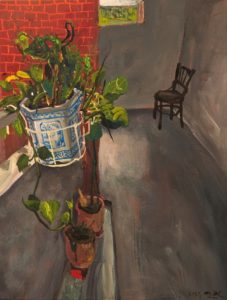
Fig. 1. PASILYO NG ALA-ALANG IIWANAN
PASILYO NG MGA ALA-ALANG IIWANAN gives that sensibility its quiet architectural form. A Delftware planter, dense with cascading foliage, occupies the foreground with unexpected authority. Vines spill across the ledge and quietly interrupt the corridor that stretches toward an empty wooden chair withdrawn into shadow. The eye lingers between those two points, where lush growth encounters an interior marked by absence. The passage itself becomes the painting’s true subject. The imported ceramic vessel recalls a distant cultural lineage, yet the living plants have long since folded it into the rhythms of ordinary domestic life. The title deepens that quiet displacement. The corridor ceases to function as a simple interior. It becomes a threshold where memory neither departs nor returns, but remains suspended between both. Miel entrusts remembrance to humble objects rather than monumental symbols. Space itself learns to remember. Silence acquires the density of lived time.
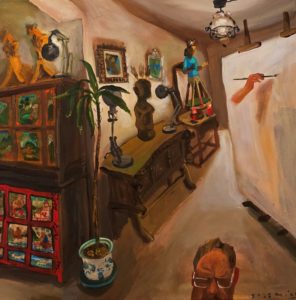
Fig. 2. STUDIO
STUDIO extends the meditation on Isip into the intimate theater of artistic creation. A disembodied hand appears from behind a blank canvas, while Miel places his own head at the lower edge of the composition. The body never fully enters the room since the painter’s consciousness disperses across the studio, where vision, memory, and gesture remain suspended before they recover their unity in paint. The untouched canvas occupies the visual center, yet it offers nothing to the eye. Rather than receive an image, it withholds a central focus. The surrounding interior unfolds as a liminal archive where artistic consciousness gathers its material. A Bulul figure faces a Delftware planter. An imposing cabinet recalls the display furniture of seventeenth-century Europe, although its painted panels drift toward the lyricism of Chinese landscape painting. A crowned devotional figure rises between two candles, where folk piety brushes against theatrical artifice. None of these objects submits to a singular historical lineage. Each carries the residue of another world, although none remains confined to its place of origin. The studio becomes less a site of production than a place of negotiation, where inherited histories suspend their fixed identities before they assume another life in paint.
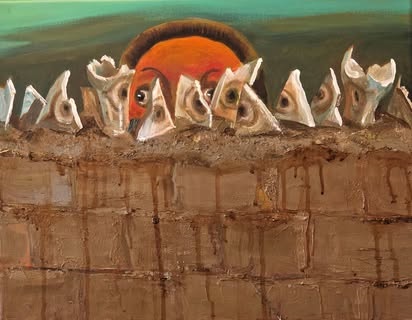
Fig. 3. CHISMOSA PANOPTICON
The domain of Isip gradually abandons quiet meditations on memory and turns toward sharper social tensions. CHISMOSA PANOPTICON ruptures that stillness with a concrete wall crowned by broken glass. Each shard contains a human eye. What should deter intrusion instead invites relentless surveillance. The barrier no longer protects private space. The barrier watches. A face rises just above the wall, although the broken glass conceals much of its presence. The figure peers across the partition with anxious curiosity, yet the embedded eyes deny any stable distinction between observer and observed. Every glance returns another gaze. Miel transforms an ordinary neighborhood fixture into an unsettling meditation on social vigilance. Gossip no longer resides in speech alone but acquires a material form that polices everyday life with quiet persistence.
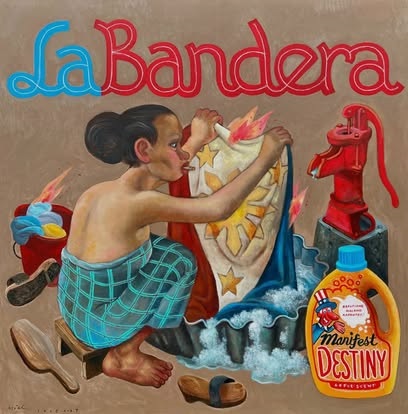
Fig. 4. LABANDERA, LA BANDERA, LABAN!
LABANDERA, LA BANDERA, LABAN! draws the domain of Isip toward the contested terrain of national memory. A woman scrubs the Philippine flag beneath the flow of a hand pump, yet flames continue to consume the fabric. Cleansing fails to extinguish the fire. Every stroke of labor exposes a wound that refuses purification. The painting adopts the saturated language of commercial advertising. A detergent bottle bears the label Manifest Destiny, and the promise of spotless renewal collapses into irony. The slogan invokes an imperial doctrine that once justified conquest, while the product itself offers a fantasy of historical erasure. Miel refuses that promise. Water cannot erase the burns that mark the flag. Labor cannot restore an innocence that history has already consumed. The domestic act assumes political force. Care for the nation passes through ordinary hands, although the marks of colonial violence remain visible upon the cloth they struggle to preserve.
Where the Dominion of Ipis Clings
By this point, the slip of the tongue no longer appears accidental. The exhibition has quietly prepared the passage from Isip to Ipis. Reflection yields to instinct. Recognition gives way to unease. Several works no longer seek contemplation through historical memory. They confront the senses through material weight. Pigment grows thick and opaque. The surface resists the eye, while distorted faces erode the comfort of recognition. Ordinary life acquires an abrasive texture that unsettles without spectacle.
-
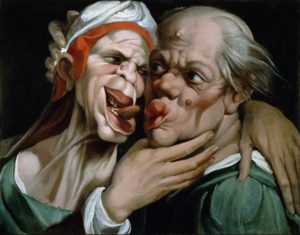

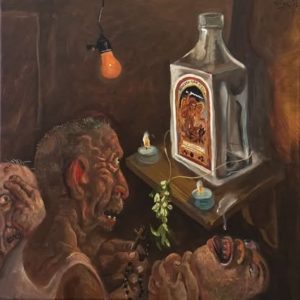
- Fig. 5.1. DEBOTO/ DEBOTE
-

- Fig. 5.2. Caricature – BARTOLOMEO PASSAROTTI
DEBOTO OR DEBOTE marks that transition with unsettling force. A bottle of Ginebra occupies the place of a devotional image, while votive candles and a hanging bulb cast an uncertain glow across the cramped interior. Men crowd the improvised altar with expressions that recall the exaggerated physiognomies of Bartolomeo Passerotti, although Miel drives those features toward something grotesque and nearly cadaverous, if not zombified. One man clasps a rosary. Another reaches toward the bottle with parted lips. Devotion and addiction occupy the same ritual space without clear distinction. The exposed light bulb assumes the role of a counterfeit halo, yet its weak illumination offers no promise of revelation. Faith survives in the gestures of the devotees, although the sacred object has yielded to intoxication. Miel exposes the fragile structures that persist when transcendence falls silent and ritual alone remains.
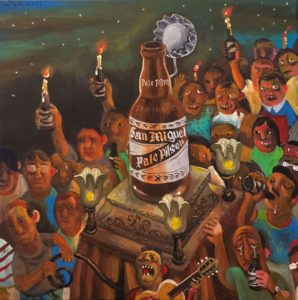
Fig. 6. PRUSISYON NG MGA LASING
A similar exhaustion anchors PRUSISYON NG MGA LASING. Movement fills the frame, yet no arrival awaits the subjects. A Pale Pilsen bottle rises with the absolute authority of an improvised procession icon. Amber light spreads like a painful bruise across clustered bodies of an ordinary crowd. Faces visibly split between transient cheer and total depletion. Candles sealed inside empty bottles mimic the posture of prayer, but the scene releases only a deep exhaustion, and it conjures a vision of belief as mere endurance sustained through ritualized piety. It is a force that persists long after its semantic value dissipates, much like the evaporated spirit of cheap liquor.
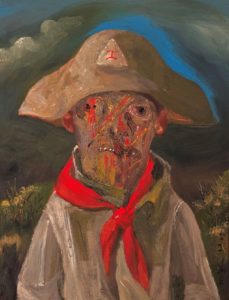
Fig. 7. EXPERIENCED KATIPUNERO
The dominion of Ipis eventually reaches the nation’s heroic archive. EXPERIENCED KATIPUNERO returns the revolutionary to the present, although the encounter offers no comfort. Deep fissures cut across the face until flesh resembles scorched earth. The eyes withdraw into darkness, while the vivid red scarf refuses the exhaustion that has consumed the body beneath it. History has preserved the uniform. History has abandoned the man. The painting refuses commemoration. Heroism no longer resides in triumph or sacrifice. Heroism survives as attrition. The Katipunero remains upright because the nation continues to summon his image, even after time has stripped away the promise that once animated it. Miel leaves the viewer before a figure who no longer embodies victory but leaves a figure who endures instead as the scar that history cannot heal.
-
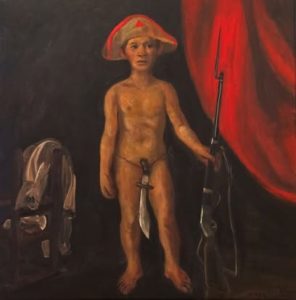

- Fig. 8. KATIPUNERO DESNUDO
-
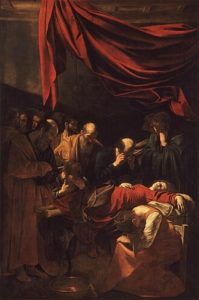

- Fig. 9. DEATH OF THE VIRGIN (1606)
KATIPUNERO DESNUDO carries the dismantling of the heroic image to its final threshold. The uniform rests upon a chair like an abandoned skin. A naked revolutionary confronts the viewer with only a Katipunan hat, a rifle, and a bolo suspended before his body. Every familiar emblem remains within reach, yet each one has lost the authority to define the figure who stands before them. Heroism returns to flesh, where vulnerability precedes every monument. The baroque crimson curtain recalls Caravaggio’s Death of the Virgin, where sanctity yields to the undeniable weight of mortal existence. Miel invokes a similar gravity. The revolutionary stands outside the comforts of patriotic spectacle and enters the fragile condition of an ordinary body. Memory therefore seeks its measure in exposed skin rather than ceremonial attire. Beneath the symbols that history has cherished stands a man who bears the full cost of the nation that continues to remember him.
-
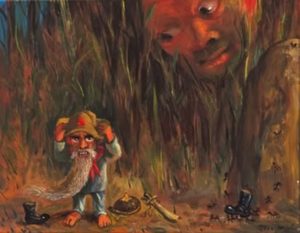

- Fig. 10. KATIPUNERONG NUNO SA PUNSO
-

- Fig. 11. SATURN DEVOURING HIS SON (1819-1823)
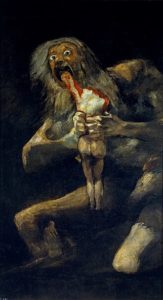
This physical vulnerability extends into the mythical realm. In KATIPUNERONG NUNO SA PUNSO, the revolutionary crosses into the domain of local folklore and returns diminished rather than monumental. A colossal Kapre looms above him, its immense face suspended between curiosity and appetite. Beneath that gaze, the Katipunero appears as a barefoot nuno who clutches his hat with quiet apprehension. The republic’s hero suddenly enters a world where older powers hold dominion. Along the earthen mound, a line of ants bears a discarded boot with the solemn rhythm of a ritual offering. Their patient procession transforms the remnants of history into an obscure ceremony. The looming Kapre recalls the terrible expectancy of Francisco Goya’s Saturn Devouring His Son, yet Miel withholds the moment of consumption. Terror lingers in suspension. Folklore, colonial memory, and the natural world converge within a single field, where the nation relinquishes its claim to permanence before older myths and humbler forms of life.
Ipis emerges where the architecture of certainty begins to erode. Every promise that once organized the world gradually yields to the stubborn persistence of what remains. Faith continues after revelation withdraws. Heroism endures after history relinquishes its monuments. Memory abandons the security of origin and settles instead upon the vulnerable surface of the body. Existence acquires a different gravity under these conditions. Survival ceases to anticipate redemption. Survival becomes its own irreducible horizon. Miel reveals a world sustained less by hope than by the quiet insistence of lives that continue after every grand narrative has spent its claim upon them.
“Bagabag” in Bagabag
BAGABAG gathers the exhibition into a final image where the distinction between Isip and Ipis relinquishes its hold. An immense back fills the canvas until the body assumes the scale of a landscape. The turned head withdraws from the viewer, while the skin parts into incandescent fissures that glow like volcanic seams beneath the earth. Small creatures cling to the flesh, shelter within those openings, or drift toward another wound with patient resolve. Their forms refuse certainty. They resemble parasites, yet their curled bodies carry the quiet poise of embryos. One folds inward. Another stretches toward the light. Another seems to rise from the wound itself, as though the flesh had begun to dream another life. Every incision wavers between injury and genesis.
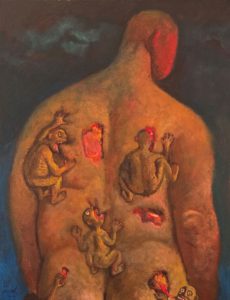
Fig. 12. BAGABAG
The body yields its familiar boundaries. Flesh becomes terrain. Wounds become dwelling places. Anguish relinquishes the character of interruption and assumes the slow rhythm of habitation. Thought inscribes itself upon the skin, while memory abandons the permanence of monuments and enters the vulnerable grammar of scars. BAGABAG refuses every clear distinction between affliction and vitality. Each wound shelters the possibility of emergence as much as the mark of injury. Miel leaves the viewer before a body where history, consciousness, and desire occupy the same living surface. Endurance reaches its deepest register here, beyond triumph, beyond consolation, where existence persists with the quiet gravity of a world that continues to bear life through its own brokenness.
Works Cited
- Doloricon, Neil. “Cuentos Interruptus: DengCoy Miel’s Alternate Universe.” Manila Standard, 30 Aug. 2019, https://manilastandard.net/?p=303684.
- Garing, Thea. “Excerpt.” Mga Kathang Ipis: Exhibition Catalog, curated by Prudencio “DengCoy” Miel, 2024.
- Ladrido, R. C. “Dengcoy Miel Tackles West Philippine Sea in ‘Sacred Shores’ Exhibit.” VERA Files, 20 July 2024, https://verafiles.org/articles/dengcoy-miel-tackles-west-philippine-sea-in-sacred-shores-exhibit
- Ruiz, Jose Tence. “‘DengCoy’ Miel holds first one-man exhibit.” INQ, 2 May 2016, lifestyle.inquirer.net/227850/dengcoy-miel-holds-first-one-man-exhibit/
- Yuson, Alfred A. “Art That Toggles Between Power and Delusion.” The Philippine Star, 17 Dec. 2018, https://www.philstar.com/lifestyle/arts-and-culture/2018/12/17/1877481/ art-toggles-between-power-and-delusion
Disclaimer: The views expressed in this critique are solely those of the author and do not necessarily reflect the views of the Kalaw-Ledesma Foundation, Inc. (KLFI).
Images accompanying this critique sourced by the author are used here for educational purposes only. KLFI does not claim ownership of these images, all rights remain with their respective owners.