



What made you apply for the grant?
I was already conducting research on the intersections of basketball and art when I first visited the archives in the PKL Center. During that initial visit, I discovered materials that directly and unexpectedly spoke to my inquiry. Realizing that the archive held more than I had anticipated, applying for the grant felt like a natural next step.
What are the highlights of doing research / implementing your project at the PKL Center?
One of the greatest highlights was being able to sift through the archives for full days. Each box opened new pathways and possible trajectories for the research.
Collaboration was another defining experience. Working with artists/athletes, and scholars who have devoted themselves to Philippine basketball and art affirmed the richness of this convergence between art and sport. Being featured by [basketball brand] SLAM PH was particularly meaningful (Thank you, Jon Rodriguez) it signaled that this dialogue between two seemingly distinct fields is both visible and vital.
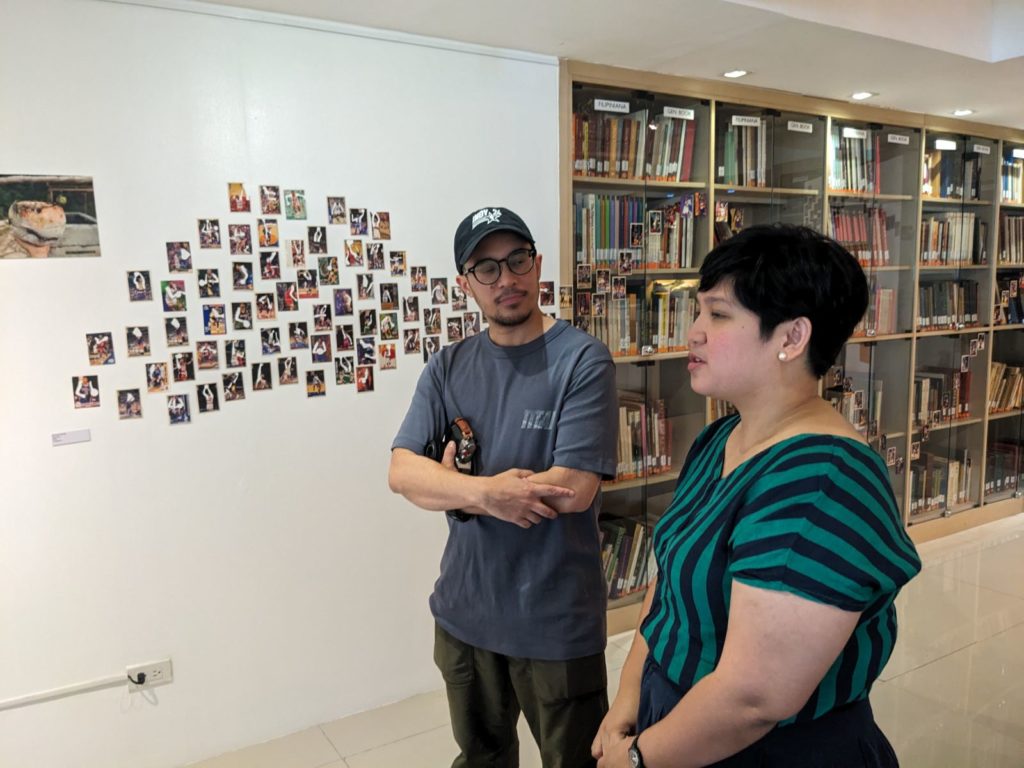
Jon Rodriguez (SLAM PH) with Sofia Santiago-Jimenez.
The project also allowed me to engage in conversations with Ronyel Compra, Dayong Mendoza, Carla Gamalinda, Charles Salazar, Marcus Nada, and Aila Torre, and to interview James Owen Saguinsuin and Rafe Bartholomew. Recording these exchanges was invaluable. Aside from learning about their processes, I was struck by how differently each of them approached and appreciated the project. Their stories expanded the project in ways I could not have anticipated.
Another highlight was visiting Botong’s studio in Angono and spending time with his grandson, Sir Totong Francisco. We encountered supplemental archival materials there that entered into dialogue with what is housed at PKL. Finally, Reconnecting with Jo Tanierla of Tambisan Sa Sining to feature a study of one of their murals further reinforced this idea: “the game” extends beyond the walls of PKL.
At its core, the project reflects on labor, precarity, and aspiration. Our workers, whether in art or in sport, often find themselves at the losing end of unequal systems. Yet there is something immaterial that persists. As one reflection in the exhibit suggests, “The Brown Man” offers what is immaterial. The game continues, even when the odds are uneven.
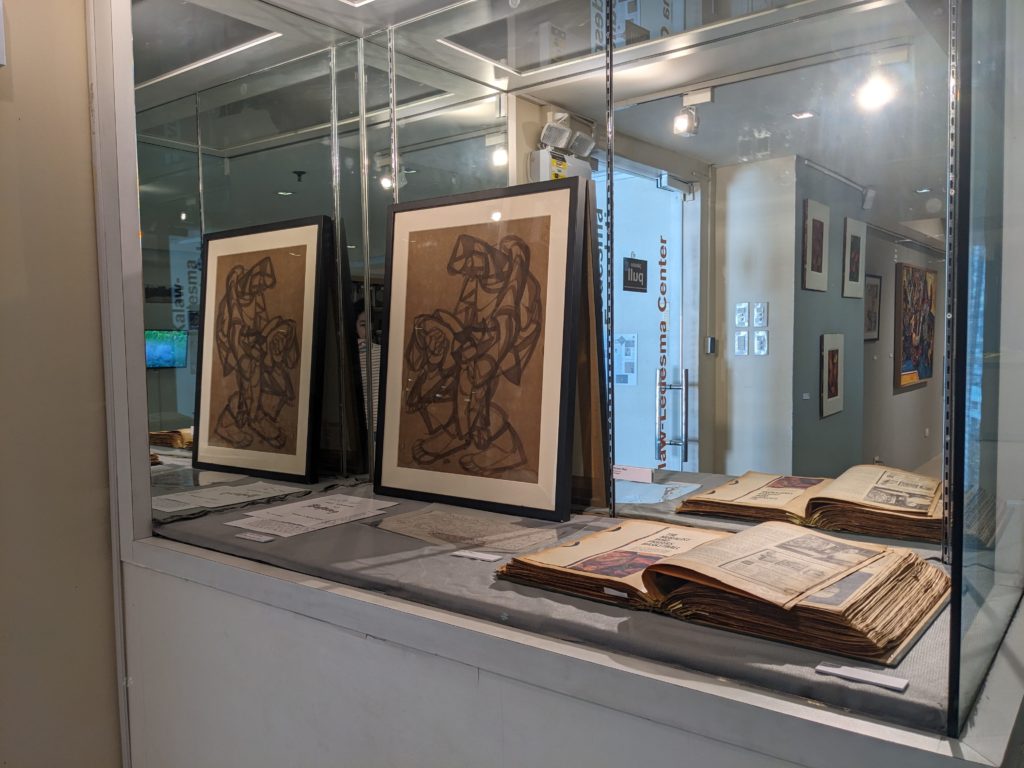
Exhibit view including “Brown Man” (ca. 1950) by Arturo Luz.
How was your experience working with the KLFI team?
Working with the KLFI team was seamless and genuinely enjoyable. Special thanks to Lk, Ms. Clavel, and Mayumi for their generosity and patience, especially with my many (and sometimes silly) questions. Their support made the entire process smooth.
How are you planning to expand your project after the grant?
I am currently exploring other venues and funding opportunities to allow the exhibit to travel. I would love to see it shown across regions, and possibly timed with UAAP or FIBA seasons, where conversations around competition, performance, and national identity are already heightened.
The themes of the project remain timely. People continue to compete for limited slots in both the art world and the sports arena. Athletes get injured; statistics fluctuate; exhibitions and proposals do not always go in our favor. Yet, as Charles Salazar said in one of the recorded conversations for the project, “we show up when it counts.” That ethos extends beyond the court.
While awaiting the next iteration of the project, I encourage everyone to continue supporting the artists involved: follow The Baller Room on Instagram, this is a community where music, art, and playing ball converge. Also visit Ronyel’s and Sir Dayong’s exhibitions or games, read Carla’s essays online, purchase Aila’s merchandise, and look out for Marcus’ illustrations in bookstores. Their practices are dynamic and ongoing.
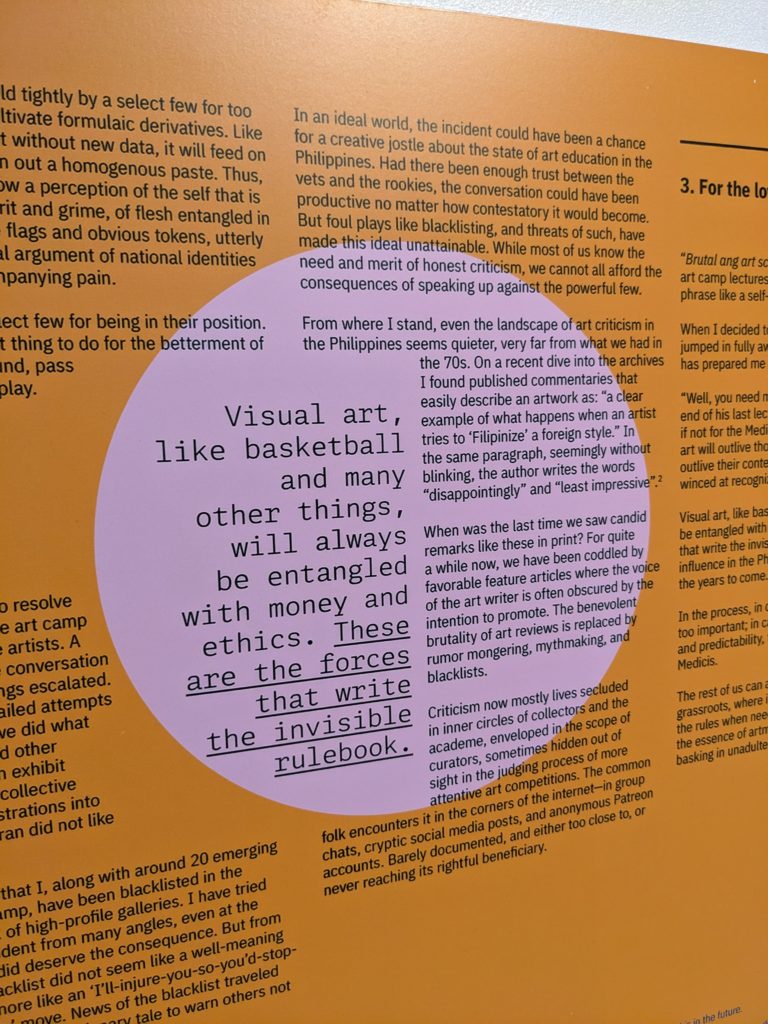
Carla Gamalinda’s essay “Reflections on the Philippine art scene’s manly competitions and dirty plays” included in the exhibition, which can also be read online on Cartellino.
Any tips for those currently writing their proposals?
Be clear about the questions you want to pursue. A strong proposal begins with intellectual clarity and intentionality. At the same time, resist becoming too fixed on your initial vision. Leave room for discovery. Some of the most meaningful aspects of a project are “happy surprises.”

MARIA SOFIA AMPARO SANTIAGO-JIMENEZ is a cultural worker, a lecturer at Far Eastern University’s Institute of Education, and PhD student taking up Philippine Studies at University of the Philippines-Diliman. She co-founded Museum Collective PH to create critical programs on memorialization, contested histories, and Southeast Asian Contemporary Art. Her work has been supported by Asian Cultural Council, Kalaw-Ledesma Foundation, and the Japan Foundation-Manila grants.