



by Emman Baldonado
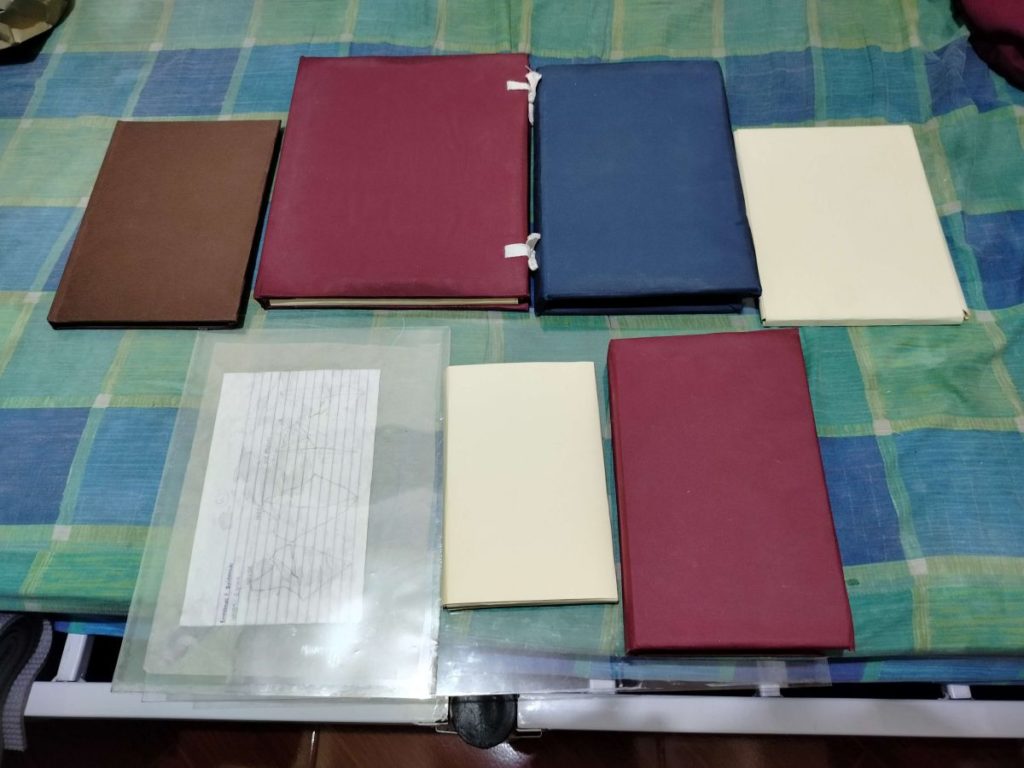
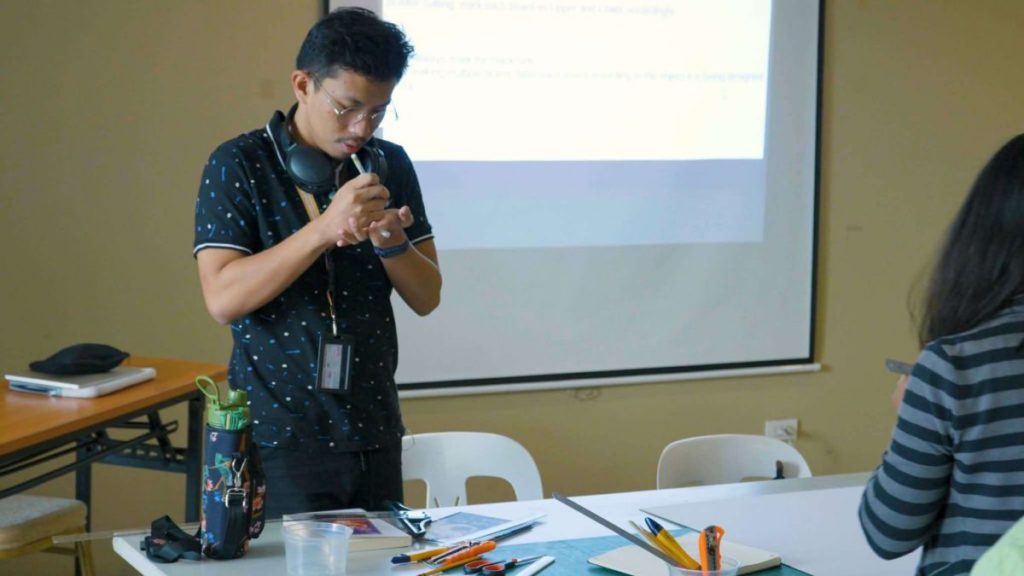
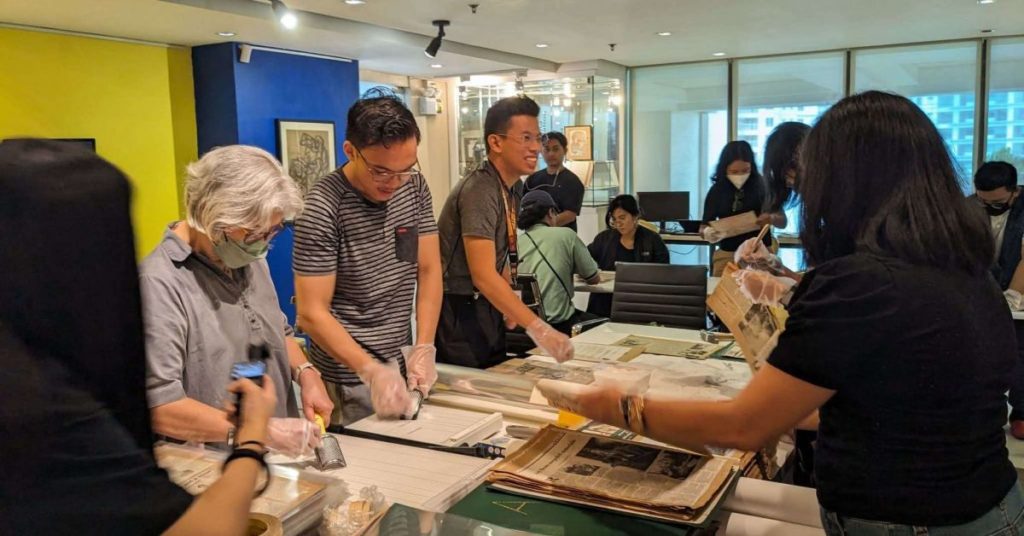
Having been part of the scrapbook conservation internship program of the Purita Kalaw-Ledesma Center earlier in 2024, I have grown to be familiar with its history, identity, and mission as an art institution that aims to promote, preserve, and provide access to Purita Kalaw-Ledesma’s artistic legacy and to Philippine and Southeast Asian modern art. I understood the weight of the familial heritage that the Center strives to articulate given Purita’s incomparable contributions to the development and documentation of Philippine art, as someone who also endeavors to keep alive the memories of my own family (especially those of my grandmother), and I was also able to firmly grasp the social responsibility borne by the Center in safeguarding these contributions to ensure that they can be equitably acknowledged, utilized, and bequeathed by Filipino artists in the future. And so, when the Center released a call for interns last year, I did not hesitate to apply once more, eagerly looking forward to drawing new connections among artistic practice, information work, and the power and value of the past-made-present, just like when I first began as an intern conservator of the Center—but now through the lens of the current and the present as a full-fledged library intern.
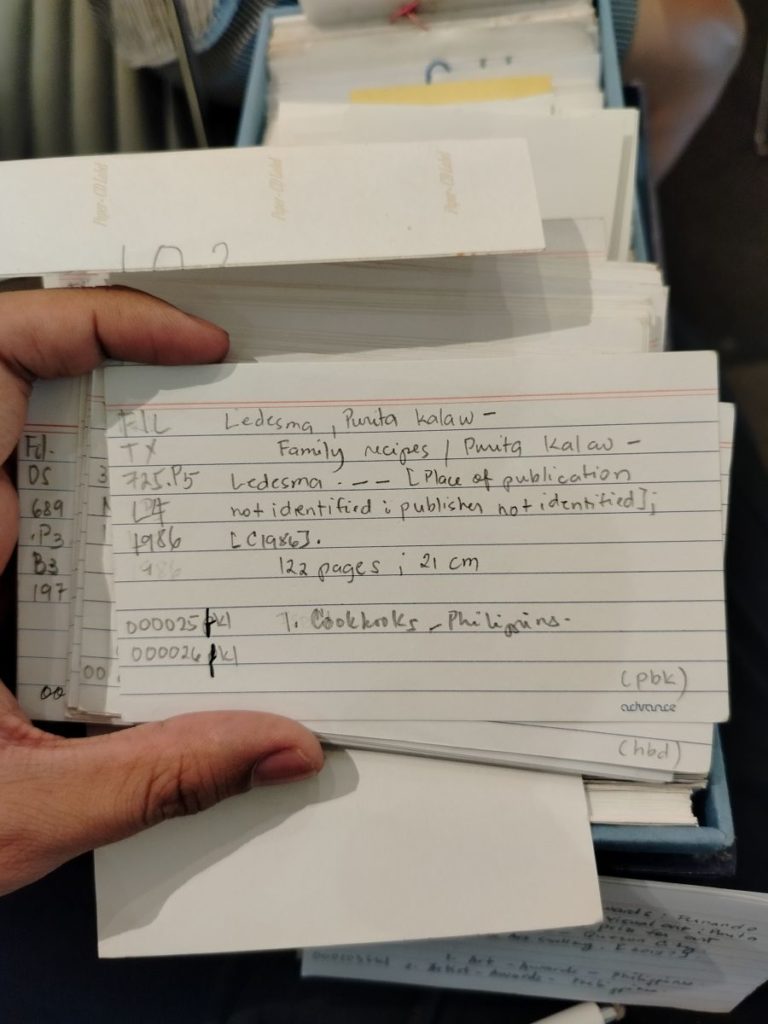
A catalog card entry of Purita Kalaw-Ledesma’s book, Family Recipes, cataloged following the rules of the Resource Description and Access (RDA) standard during the initial establishment of the Center’s library. Despite the ubiquity and extensive organizing power of electronic and digital information systems, manual cataloging committed to and arranged through index cards still prove to be the Filipino librarian’s fundamental skill in information organization, allowing for the effective creation and management of catalogs even without the affordances of modern technology.
My time as a library intern of the Center began in earnest in April 2025, focusing now not on the preservation of the past as what I did during the conservation of Purita’s scrapbooks, but the activation of the present: the cataloging of the newly acquired library materials of the Center as part of its current endeavor to vitalize its library collection to provide improved information services to its clientele. I also supported the Center throughout the duration of my library internship in its other functions and activities, such as in its regular reference services, extension programs, and applications for institutional recognition. As I carried out information work that was directly tied to the artistic visions and practices embodied and carried out by the Center, I was able to work directly both with the people forming the institution and the community that it supports and enriches, providing me the engagements and the mindspace that I need to connect art and information together.
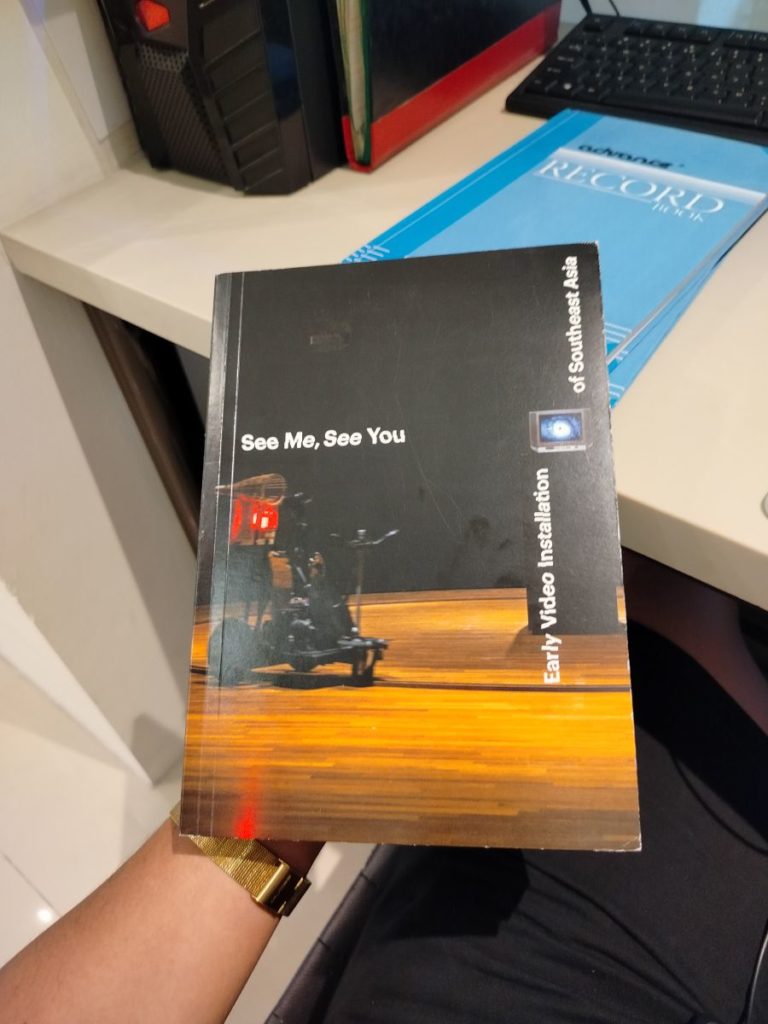
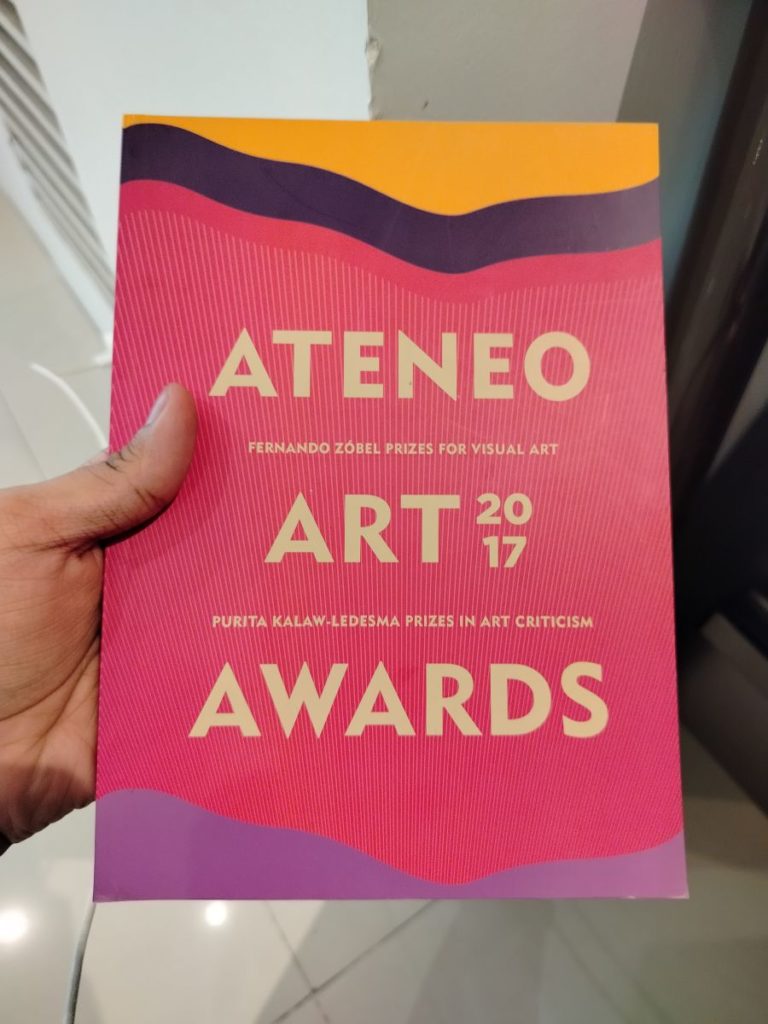
See Me, See You: Early Video Installation of Southeast Asia published by the National Gallery Singapore and the book for the Ateneo Art Awards 2017 published by the Ateneo de Manila University. These two institutions work closely with the Center in advancing modern art practice and art criticism in the country and in the wider Southeast Asian region.
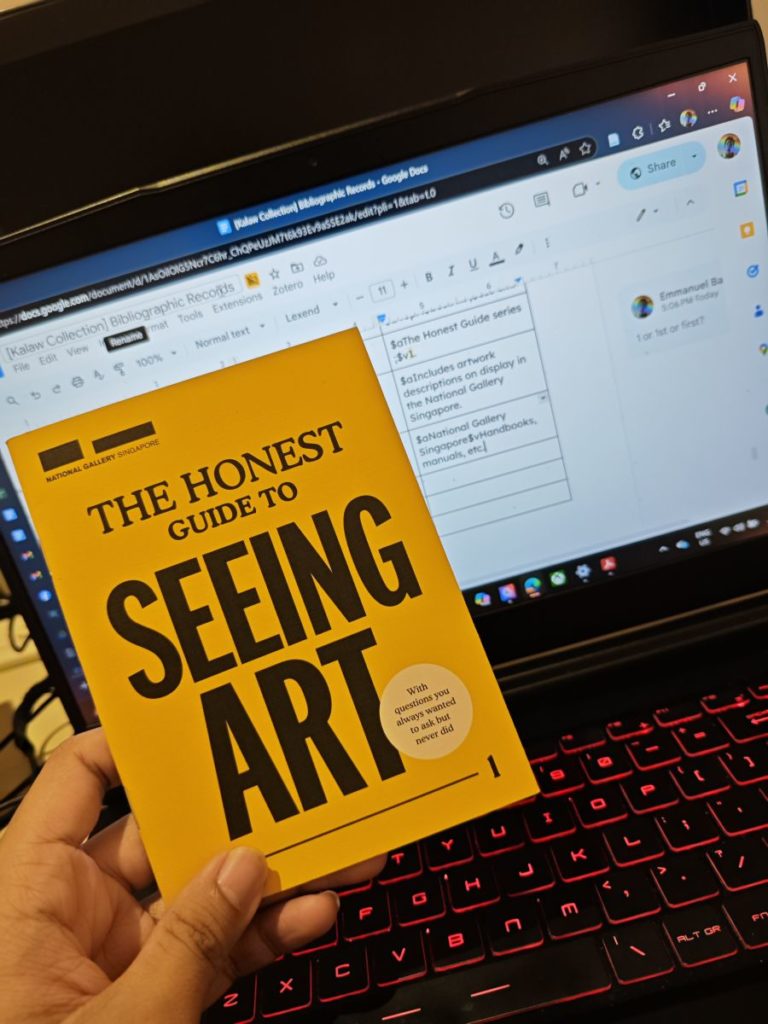
The cataloging process requires both technical and contextual approaches to describing and assigning access points to all types of information resources, always with the potential user in mind; in this case, by cataloging the series, additional descriptions, and subject content associated and contained with The Honest Guide to Seeing Art, anyone who tries to look for this particular resource will be able to obtain and use it through their access point of choice or circumstance. In its own way and right, cataloging (and information organization in general) is an art form—it is the art of access.
By the time of my library internship, my knowledge and perspectives on information work have expanded beyond the original limits of what I knew and understood as a library and information science (LIS) student. At first, I was particularly inclined to the archival aspects of my field, which was what also led me to my stint as an intern conservator of Purita Kalaw-Ledesma’s renowned volumes of scrapbooks that sketch out the vivid history, development, and transformations of Philippine modern art. But as I advanced through my academic courses, I also began to develop a deeper appreciation of the larger dimensions of information work that underpin the management and preservation of both past and contemporary information, which are also oftentimes the ones that are lesser-known and oft-unseen, such as the organization of information (i.e., the study and practice of systematically describing and arranging collections of information resources to provide access to users). As I cataloged various types of materials that all told me about the richness and enduring value of Philippine and Southeast Asian art, from art encyclopedias and journals to exhibitions catalogs, collections of essays, and the biographies of some of the most renowned Filipino artists, and were in themselves works of documentary and literary art, I asked myself: why does art remain so elusive and unreachable in a country so full and bursting of it? Why, despite our talents and achievements in its study and practice, can our art feel so remote, removed, and incomprehensible to us—despite me cataloging literal representations of art for an art institution?
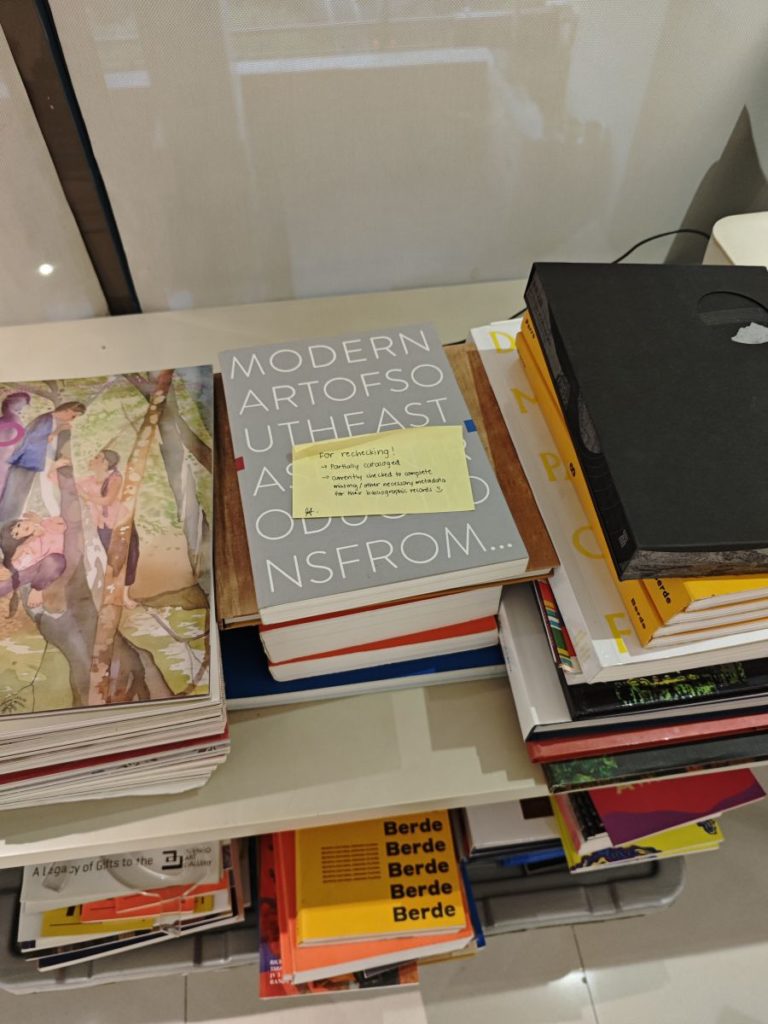
Stacks of information resources on Philippine and Southeast Asian art, soon to be incorporated into the library collection of the Center. There is no denying that we possess so much art and we also have the vast bodies of information needed to sustain it—but the problem lies, yet again, in access: who gets to access art, how art is made (in)accessible, and why should art be accessed at all.
This notion of inaccessible art is not new to us. We know that structural barriers exist in accessing and understanding art (and a lot of other things in life as well), from gender, age, and education to ethnicity, nationality, and class. But information is also a structural aspect of our society, to the point that it is embedded deep within our societal fabric through its own infrastructure, with systems of describing, arranging, presenting, disseminating, and preserving information fundamentally shaping how we search, understand, know, and take action. And our current information systems, from those that organize our libraries, archives, galleries, and museums to those that enforce the algorithms and programmings of our televisions, radios, and social media platforms, are responsible for the inclusion or exclusion of art in our collective stream of knowledge and memory. In our case, we can see the disconnection of our art from the bodies and systems of information and knowledge in which they should be represented and embodied, due to the tyrannical ineffectivities of old infrastructure, the absence of political acumen in effectuating changes to processes and systems, and the lack of social spaces in which we can freely and securely share information without paywalls, surveillance, and discrimination and bigotry. We have the art, indeed, we have drawn it in—but the information, the canvas itself through which we will present this drawing, is yet to be sewn and seen as a whole. The inaccessibility of our art illuminates its disorganization in our information sources, channels, structures, and architecture—a problem central to us in the field of LIS, for which we must be held accountable and create new solutions that reimagine the connection of art and information as the expressive, creative, and aspirational contextualization and application of deeply human data.
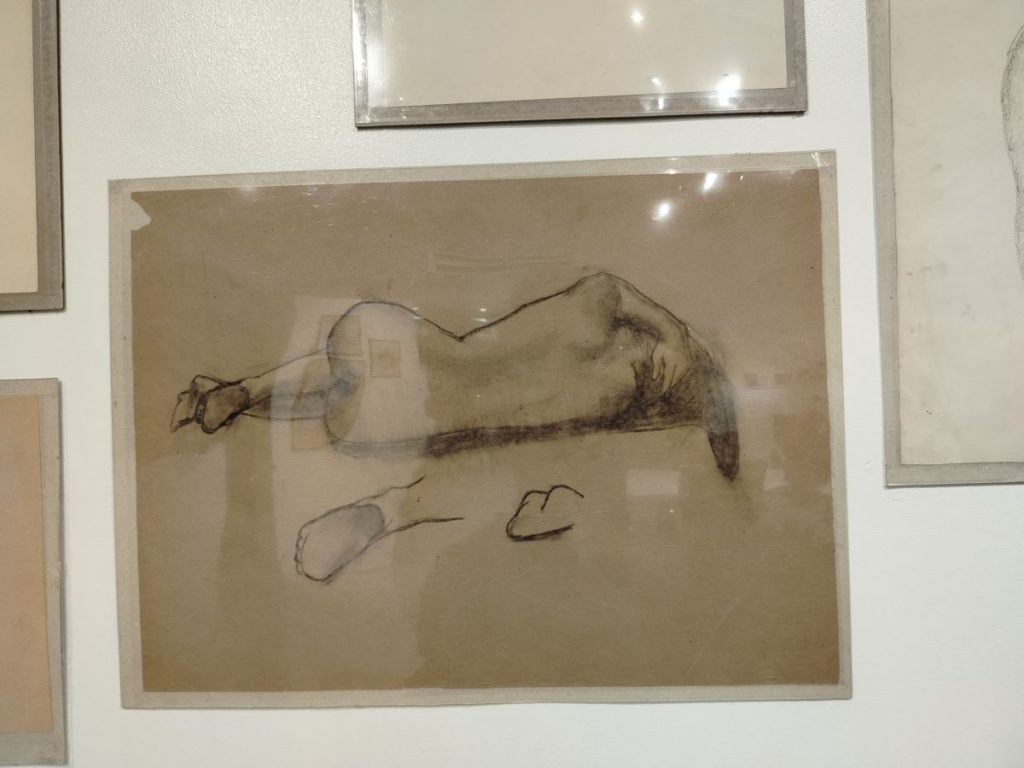
A nude sketch of a person lying down in a fetal position, displayed during the exhibit, ‘Drawing from Life: Purita’s Artistic Impulse and the 1970s’. During this time period, Purita was filled with creative energy, creating these sketches as part of the sketching sessions of the Saturday Group in addition to publishing two major written works (The Struggle for Philippine Art and Edades: National Artist) and continuing her eternal commitment to scrapbooking. Her streak of creation reflects the dynamics of art as a form of information: expressive, engaging, effervescent, and empowering.
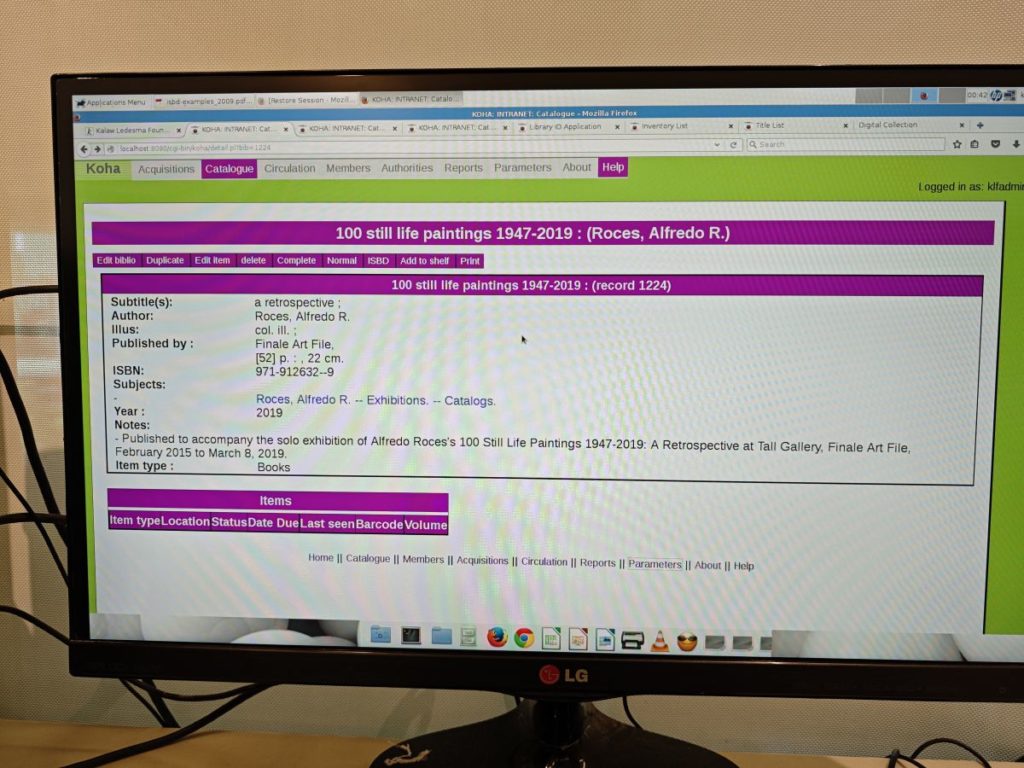
Throughout my internship, I did not find definitive answers to the quandaries of bridging information and art, but only satisfying ones—answers that work well enough to confront realities, propose ideas, and strengthen the resolve to continue doing connective and inclusive information work. All the time that I have spent painstakingly documenting print material metadata and translating it into machine-readable cataloging (MARC) format for entry into an electronic library system has taught me well that art, as a form of information, is very much layered, loaded, and colored as any other kind of information; the complexities of artistic representations and manifestations call for nuanced, sensitive, and comprehensive communication and dissemination across the public sphere that gives respect to their creation, provenance, meaning and value, material conditions, and relations to other works, as well as to their wider sociocultural, political, and economic linkages and entanglements as points of reference that tell us about the lifeworlds in which they are created, contested, conveyed, and celebrated. My experience conducting an outreach program with the Center for the local children of a parish in Malabon has instilled in me that art education in the Philippines is not an impossible struggle but rather a sustained collective mission that requires the active collaboration of institutions, organizations, and communities, as the teaching and study of art requires the consistent and dedicated cultivation of artistic literacy and lifelong creativity both in our formal and informal learning spaces. And finally, the work that I accomplished with the Center for its institutional recognition as a non-governmental organization and as its representative to the art archiving workshop held by the National Commission for Culture and the Arts for art, memory, and heritage institutions made me understand the difficulties faced by those in the field of artistic and creative work in gaining legal and social visibility and support, thus reinforcing within me the notion of solidarity among libraries, galleries, archives, museums, and other memory institutions as publicly trusted bastions of free, fair, safe, and progressive information in which all dimensions of human life and experience, art very much welcomed and included, can thrive, flourish, and be shared without fear and prejudice.
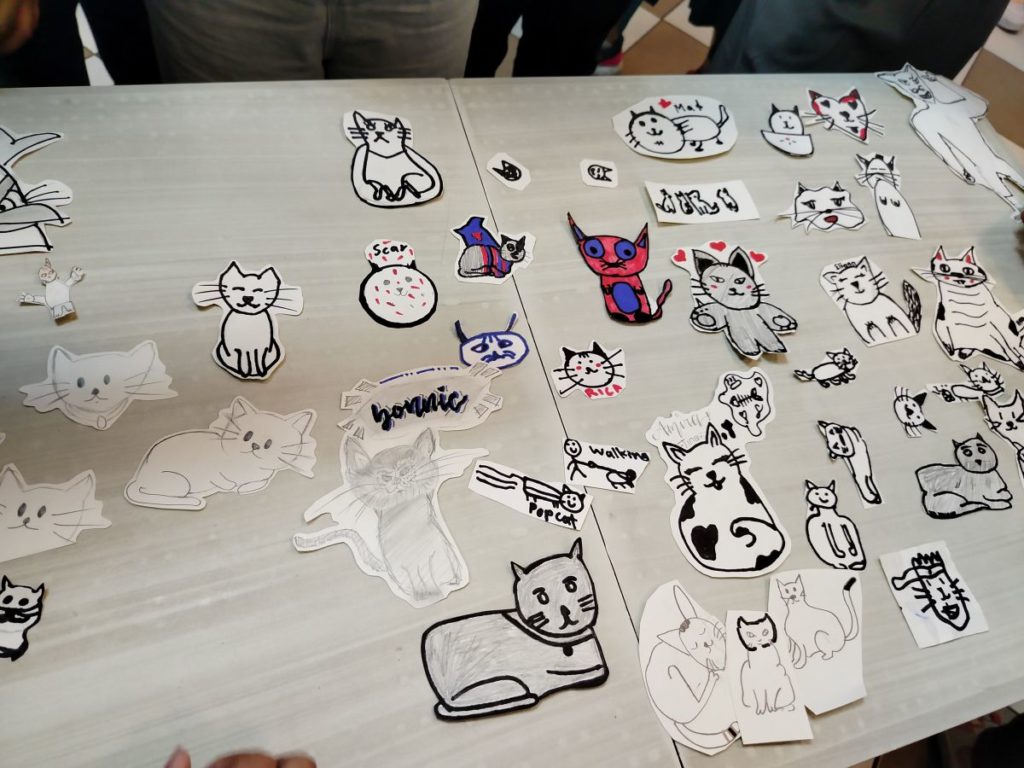
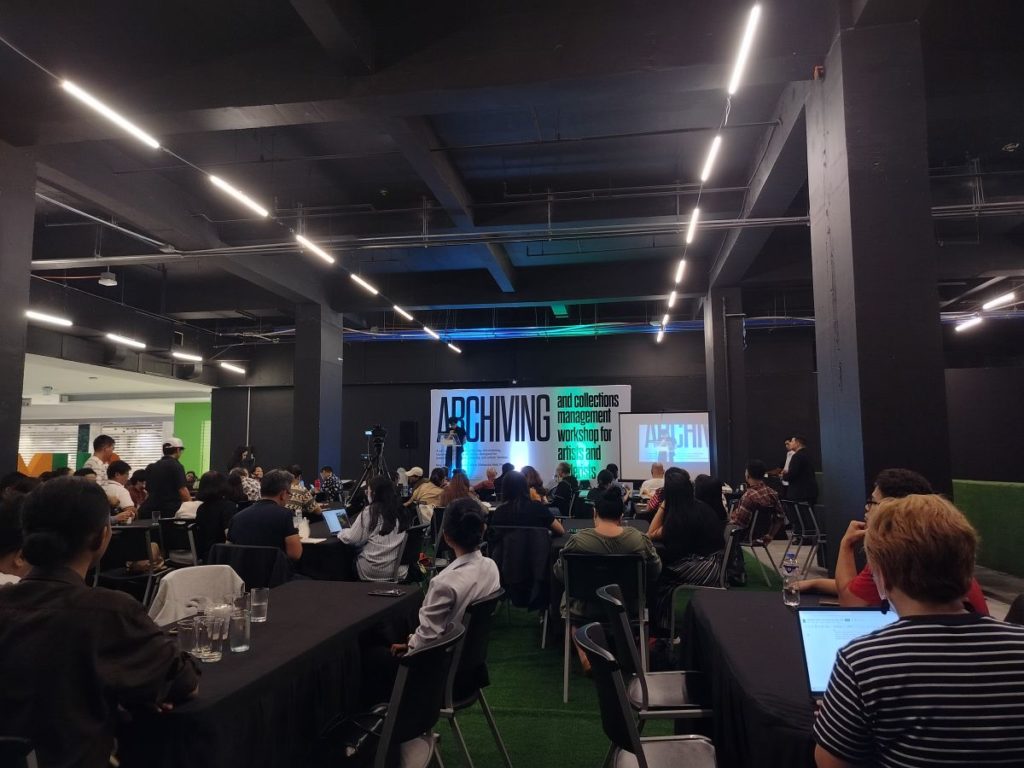
The cat stickers created by the children beneficiaries of the Center’s outreach program in Malabon, and the art archiving workshop organized by the NCCA – National Committee on Art Galleries in celebration of National Heritage Month. Both were equally crucial lessons for me in utilizing the connectivity between information and art to cultivate artistic literacy and cultures of creativity in our communities and to build solidarity among our information, memory, and heritage institutions.
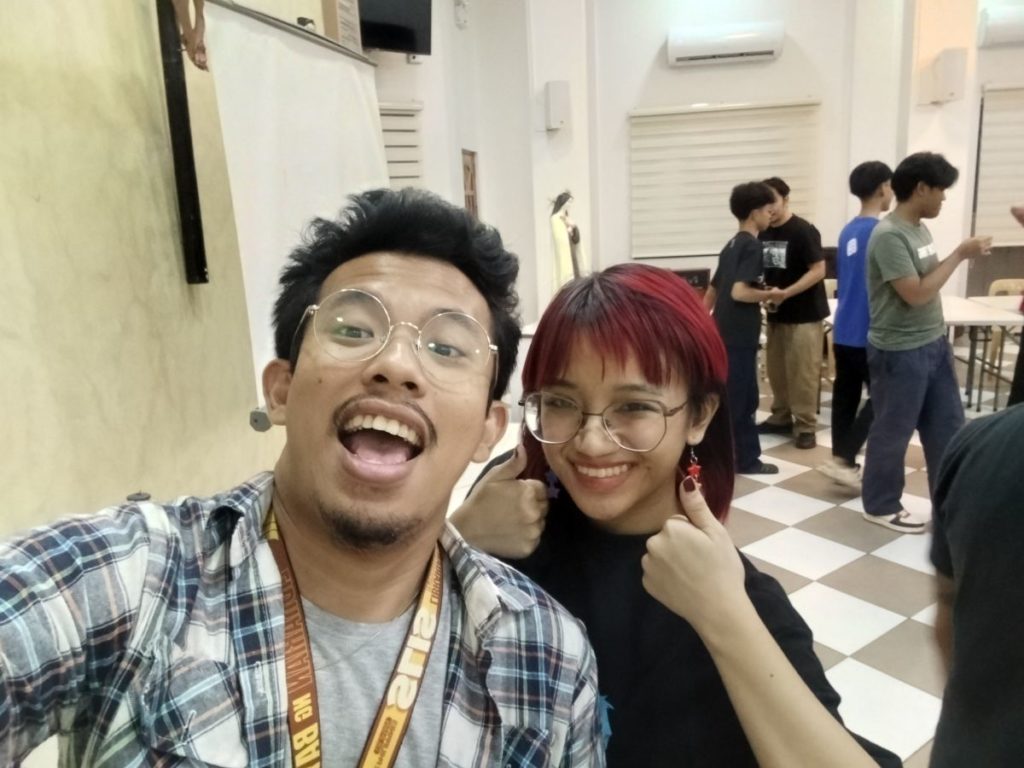
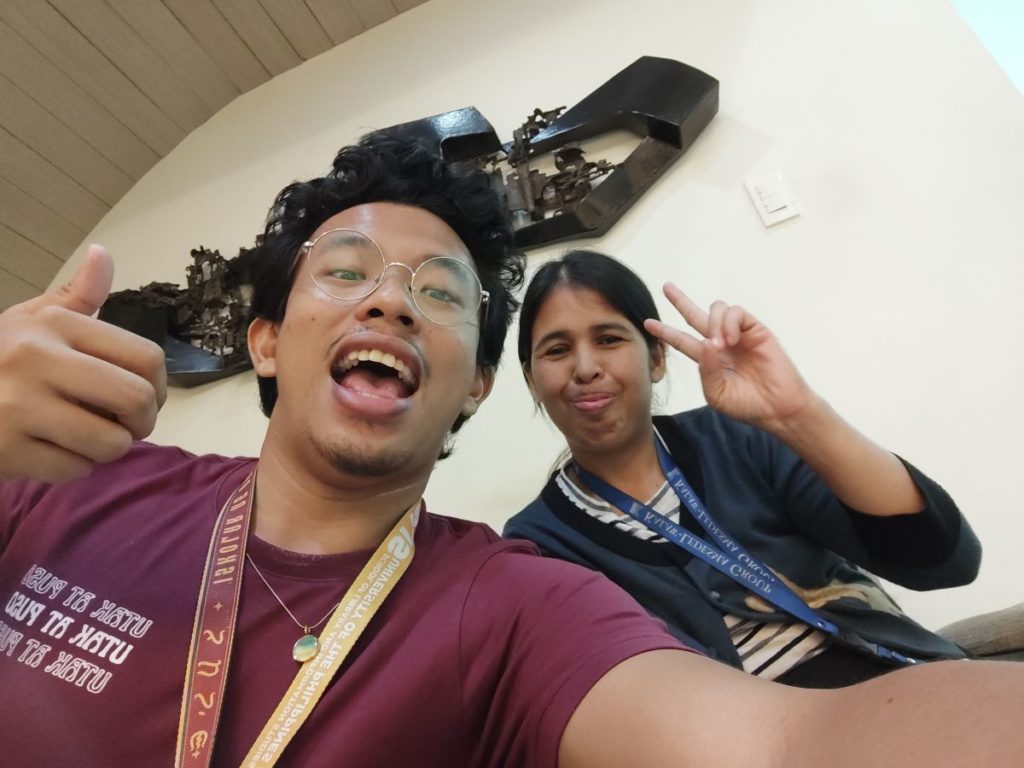
A picture of me with Wyn, my co-intern and co-volunteer organizer of the outreach program, and with Miss Clavel, one of the administrative staff of the Center who assists in overseeing its daily operations and with whom I worked with for the success of the Center’s institutional assessment. Both are truly great co-workers who helped me understand better that the art of informing is an art shared and made beautiful—and possible—with others.
The power of art to both express and inform is nowhere as evident and as useful as in the social spaces that gather and weave together knowledge and memory to tell us the colorful stories and infinite creative potential of humankind. My internship in the Purita Kalaw-Ledesma Center has given me the wonderful opportunity to bridge art and information together to improve our access, understanding, and use of Philippine modern art, and I am very much grateful to the Center and to the Kalaw-Ledesma Foundation, Inc. for granting me this undoubtedly monumental experience as a student of information and, in my own little way, a Filipino artist. May we all continue to draw the connections between art and information through our own personal and collective practices and efforts so that we can create, produce, share, and preserve works of art that equally and rightfully express, inform, inspire, and empower.
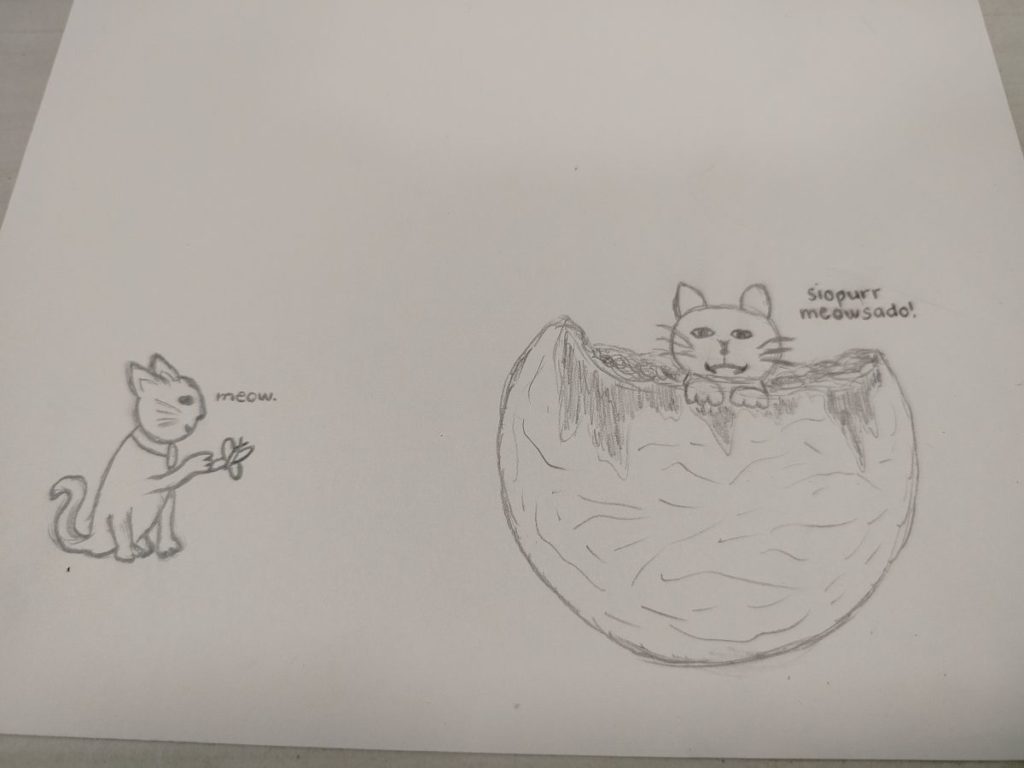
In my own little way, I am a Filipino artist, and I strive for art that gives access and nurtures lifelong learning.
—
Emman is a 4th-year Library and Information Science student from the UP School of Library and Information Studies in UP Diliman. Pursuing a multi-track program focusing on the interweaving of library and archival work, information organization and behavior, and cultural heritage, he strives to apply the theories, concepts, and ideas from the field of LIS into the crafting of helpful, effective, and inclusive programs and practices for libraries, archives, and other information centers and memory institutions. Emman loves knowing and learning the stories of people and things, and he firmly believes that more than just providing access to information resources, our galleries, libraries, archives, and museums tell us stories of life, love, and the many worlds and realities lying within and beyond our grasp that defy time, space, and perspective.
Disclaimer: The views expressed here are solely those of the author and do not necessarily reflect the views of the Kalaw-Ledesma Foundation, Inc (KLFI).