




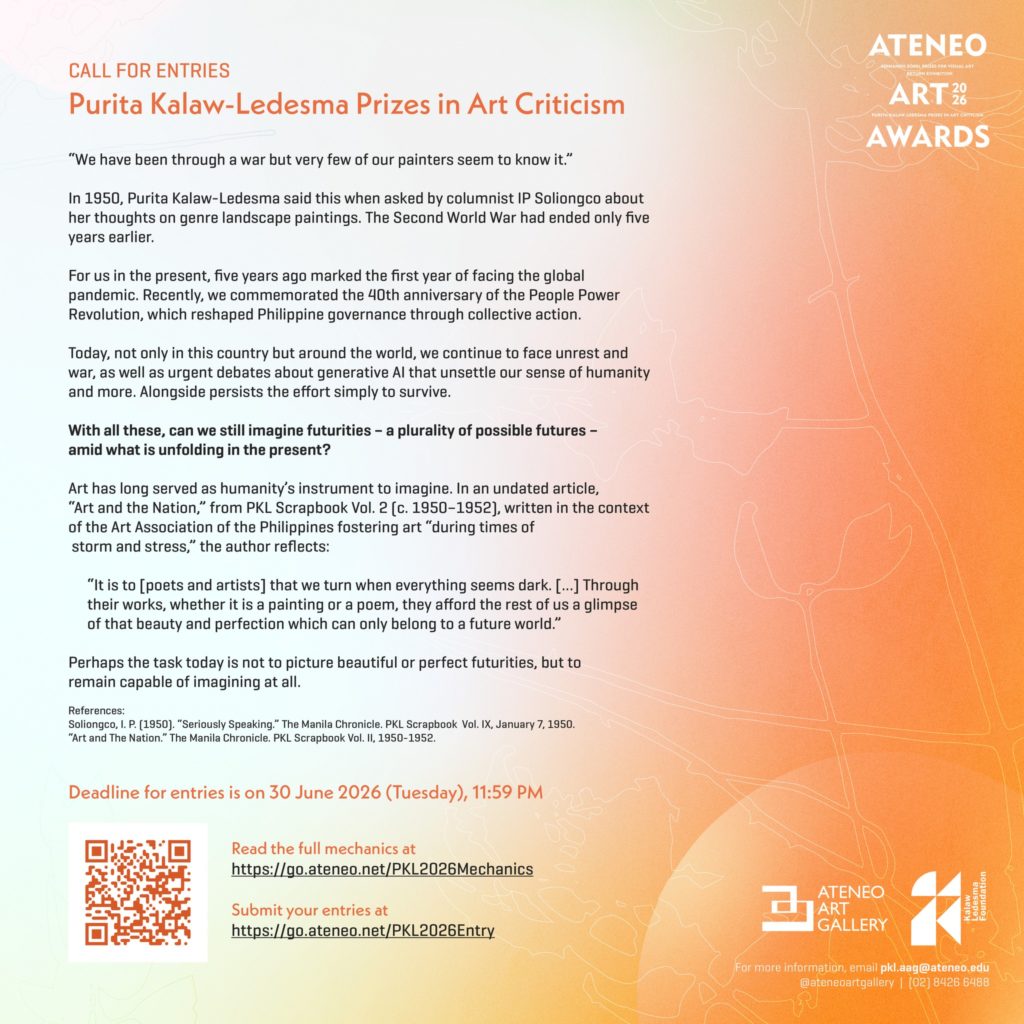
The 13th year of the Purita Kalaw-Ledesma Prizes in Art Criticism welcomes entries on the theme of Futurities.
“We have been through a war but very few of our painters seem to know it.” In 1950, Purita Kalaw-Ledesma said this when asked by columnist IP Soliongco about her thoughts on genre landscape paintings. The Second World War had ended only five years earlier.
For us in the present, six years ago marked the first year of facing the global pandemic. Recently, we commemorated the 40th anniversary of the People Power Revolution, which reshaped Philippine governance through collective action. Today, not only in this country but around the world, we continue to face unrest and war, as well as urgent debates about generative AI that unsettle our sense of humanity and more. Alongside persists the effort simply to survive.
With all these, can we still imagine futurities—a plurality of possible futures—amid what is unfolding in the present?
Art has long served as humanity’s instrument to imagine. In an undated article, “Art and the Nation” from PKL Scrapbook Vol. 2 (c. 1950–1952) written in the context of the Art Association of the Philippines fostering art “during times of storm and stress,” the author reflects:
“It is to [poets and artists] that we turn when everything seems dark. […] Through their works, whether it is a painting or a poem, they afford the rest of us a glimpse of that beauty and perfection which can only belong to a future world.”
Perhaps the task today is not to picture beautiful or perfect futurities, but to remain capable of imagining at all.
The Purita Kalaw-Ledesma Prizes in Art Criticism will have English and Filipino categories. A panel of jurors will shortlist a maximum of six (6) writers from each category. From these lists, winners will be selected by the editors of our partner publications and will be announced during the awarding ceremony scheduled in November 2026.
Two winners will be selected from the English category. The winner of the Purita Kalaw-Ledesma Prize for The Philippine Star will be awarded a regular column under ‘Platforms’ in the Arts and Culture section of the paper, to be published once a month with a total of 12 articles for a year. The winner of the Purita Kalaw-Ledesma Prize for ArtAsiaPacific will be contributing to the bi-monthly publication, with a total of six (6) articles for a year.
One winner selected from the Filipino category will be awarded the Purita Kalaw-Ledesma Prize for Katipunan Journal and will be contributing a total of two (2) articles to the bi-annual research publication.
In addition to the opportunity to have their written works published, winning writers will be eligible for month-long residencies with our partners—the Orange Project Naranja Writer’s Residency (Bacolod, Negros Occidental), The White House Writer’s Residency (San Antonio, Zambales), and Indeks (Bandung, Indonesia). The residencies will give the selected writers an opportunity to immerse and interact with local art communities in the region.
The Ateneo Art Awards – Purita Kalaw-Ledesma Prizes in Art Criticism was instituted by the Ateneo Art Gallery and Kalaw-Ledesma Foundation, Inc., in partnership with The Philippine Star, as part of the 2014 Ateneo Art Awards. It was named in honor of Purita Kalaw-Ledesma, art patron and founder of the Art Association of the Philippines, who believed in art criticism’s “vital role in the development of culture,” citing its capacity to “guide artists towards new directions and public taste towards the best in past and current artistic output.”
References:
Soliongco, I. P. (1950). “Seriously Speaking.” The Manila Chronicle. PKL Scrapbook Vol. IX, January 7, 1950.
“Art and The Nation.” The Manila Chronicle. PKL Scrapbook Vol. II, 1950-1952.
QUALIFICATIONS OF PARTICIPANTS (Updated)
- Employees, whether full-time or contractual, of the Ateneo Art Gallery, Ateneo de Manila University, or Kalaw Ledesma-Foundation, Inc., are not allowed to participate.
- The writer must be based in the Philippines for the duration of the tentative contract with partner publications (until the end of 2027).
- To avoid conflicts of interest, participants must not have a regular column and must not hold an editorial post in any broadsheet or local/international magazine. Regular columnists are not allowed to join but contributors, defined as any person whose written work is published with a byline but not identified as a columnist, may join.
- The competition is open to digital writers and/or content creators who publish original work via online journals, personal websites, social media platforms, newsletters, or independent web publications.
- Participants employed by cultural institutions, galleries, or other organizations may be subject to policies that restrict writing for external publications or projects. It is the responsibility of participants to inform their management or supervisors of their intent to submit an entry to the PKL Prize. While submission does not guarantee selection, those chosen as winners will write for our publication partners.
- Submitted entries should not cover institutions or exhibitions where the writer is directly affiliated or currently employed/featured, e.g., the writer is an employee of the institution, wrote the exhibition text, contributed to the catalog, or is an exhibiting artist of the show being covered.
- Past winners of the PKL Prize are not eligible to participate, but writers who have been shortlisted in the past may submit an entry.
MECHANICS FOR ENTRIES
- Entries should be essays with no more than 1000 words (not including footnotes, references, and image captions, if any).
- Entries must reflect the theme of the Program. This year’s theme centers on Futurities, asking the question: Can we still imagine futurities – a plurality of possible futures – amid what is unfolding in the present?
- The entry must be written on A4-sized paper. The font should be Arial, Times New Roman, or Book Antiqua, font size 12.
- Entries must be submitted digitally as both Word and PDF file attachments with no indication of the identity of the writer on the documents.
- Only one original entry, regardless of category, is allowed per participant.
- The essay should not have been published before on any printed or online platform. While we accept submissions that explore subject matter you have already written about on other platforms, we require that the prose be entirely original and unique to this publication. Authors must disclose any prior writing on the same topic upon submission to ensure the current work is a distinct and new treatment.
- Any entry that has been submitted for consideration in any other writing contest before 30 September 2026 will be disqualified.
- Entries must be uploaded at go.ateneo.net/PKL2026Entry with the following file formats with the writer’s last name and title of the entry (ex. Dela Cruz – Essay Title) as filename:
- Entry in Word document format (ex. Dela Cruz – Essay Title.docx)
- Entry in PDF format (ex. Dela Cruz – Essay Title.pdf)
- The deadline for submission of entries will be on 30 June 2026 (Tuesday), 11:59 PM.
- Copyright of entries of the shortlisted and winning writers shall be held by the writer jointly with AAG and KLFI. All shortlisted and winning essays will be published online after the announcement of the shortlist in late 2026.
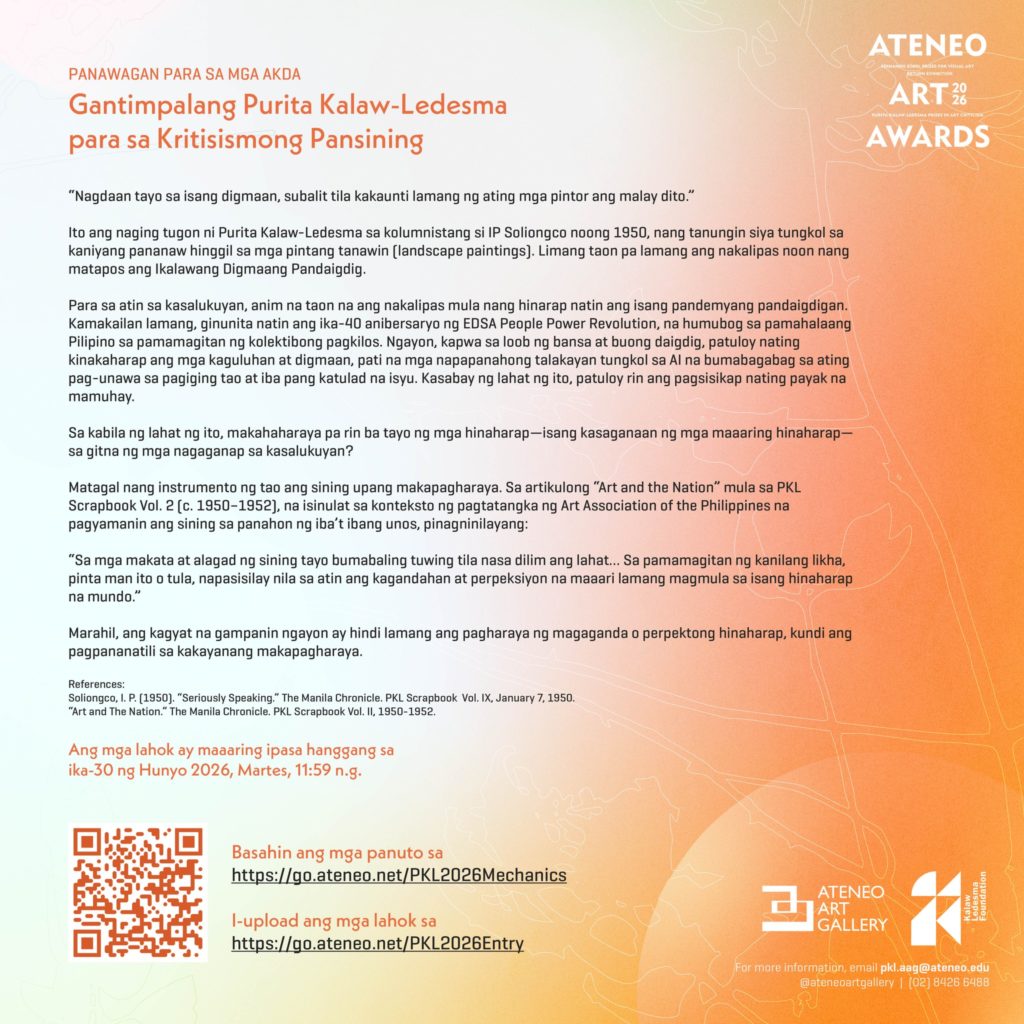
Sa ika-13 taon ng Gantimpalang Purita Kalaw-Ledesma para sa Kritisismong Pansining, bukas itong tumatanggap ng mga lahok na nakatuon sa temang Hinaharap.
“Nagdaan tayo sa isang digmaan, subalit tila kakaunti lamang ng ating mga pintor ang malay dito.” Ito ang naging tugon ni Purita Kalaw-Ledesma sa kolumnistang si IP Soliongco noong 1950, nang tanungin siya tungkol sa kaniyang pananaw hinggil sa mga pintang tanawin (landscape paintings). Limang taon pa lamang ang nakalipas noon nang matapos ang Ikalawang Digmaang Pandaigdig.
Para sa atin sa kasalukuyan, anim na taon na ang nakalipas mula nang hinarap natin ang isang pandemyang pandaigdigan. Kamakailan lamang, ginunita natin ang ika-40 anibersaryo ng EDSA People Power Revolution, na humubog sa pamahalaang Pilipino sa pamamagitan ng kolektibong pagkilos. Ngayon, kapwa sa loob ng bansa at buong daigdig, patuloy nating kinakaharap ang mga kaguluhan at digmaan, pati na mga napapanahong talakayan tungkol sa AI na bumabagabag sa ating pag-unawa sa pagiging tao at iba pang katulad na isyu. Kasabay ng lahat ng ito, patuloy rin ang pagsisikap nating payak na mamuhay.
Sa kabila ng lahat ng ito, makahaharaya pa rin ba tayo ng mga hinaharap—isang kasaganaan ng mga maaaring hinaharap—sa gitna ng mga nagaganap sa kasalukuyan?
Matagal nang instrumento ng tao ang sining upang makapagharaya. Sa artikulong “Art and the Nation” mula sa PKL Scrapbook Vol. 2 (c. 1950–1952), na isinulat sa konteksto ng pagtatangka ng Art Association of the Philippines na pagyamanin ang sining sa panahon ng iba’t ibang unos, pinagninilayang:
“Sa mga makata at alagad ng sining tayo bumabaling tuwing tila nasa dilim ang lahat… Sa pamamagitan ng kanilang likha, pinta man ito o tula, napasisilay nila sa atin ang kagandahan at perpeksiyon na maaari lamang magmula sa isang hinaharap na mundo.”
Marahil, ang kagyat na gampanin ngayon ay hindi lamang ang pagharaya ng magaganda o perpektong hinaharap, kundi ang pagpananatili sa kakayanang makapagharaya.
Ang Gantimpalang Purita Kalaw-Ledesma para sa Kritisismong Pansining ay may kategoryang Ingles at Filipino. Isang lupon ng mga hurado ang pipili ng hindi hihigit sa anim (6) na manunulat sa bawat kategorya. Mula sa listahang ito, pipiliin ang magsisipagwagi ng mga patnugot ng mga katuwang na publikasyon. Iaanunsiyo ang magsisipagwagi sa idaraos na seremonya sa Nobyembre 2026.
Dalawa ang mapipiling magsipagwagi sa kategorya sa Ingles. Gagawaran ang mananalo ng Gantimpalang Purita Kalaw-Ledesma para sa The Philippine Star ng isang regular na kolum sa ilalim ng ‘Platforms’ sa seksiyong Arts and Culture ng pahayagan na buwanang ilalathala, sa sumang 12 artikulo sa loob ng isang taon. Samantala, makapaglalathala naman ang mananalo ng Gantimpalang Purita Kalaw-Ledesma para sa ArtAsiaPacific sa nasabing lathalain na inilalabas kada dalawang buwan, sa sumang anim (6) na artikulo sa loob ng isang taon.
Ang isang mapipiling magwawagi sa kategora sa Filipino ay gagawaran naman ng Gantimpalang Purita Kalaw-Ledesma para sa Katipunan at makapaglalathala sa publikasyong pampananaliksik na ito na inilalabas nang dalawang beses kada taon, sa sumang dalawang (2) artikulo sa loob ng isang taon.
Dagdag pa sa mga pagkakataong ito para sa paglilimbag ng kanilang mga sulatin, ang mga magsisipagwagi ay maaaring mapiling maanyayahang lumahok sa isang buwang writer’s residency sa aming mga katuwang na institusyon—Orange Project Naranja Writer’s Residency (Bacolod, Negros Occidental), The White House Writer’s Residency (San Antonio, Zambales), at Indeks (Bandung, Indonesia). Ang mga manunulat na mapipili sa mga nasabing residency ay mabibigyan ng pagkakataong makibabad at makisalamuha sa lokal na komunidad pansining.
Inilunsad ang Gantimpalang Purita Kalaw-Ledesma para sa Kritisismong Pansining ng Ateneo Art Awards noong 2014 ng Ateneo Art Gallery at Kalaw-Ledesma Foundation, Inc. (KLFI), katuwang ng The Philippine Star. Pinangalanan ito sa alaala ni Purita Kalaw-Ledesma, patron ng sining at tagapagtatag ng Art Association of the Philippines (AAP), na naniniwala sa “mahalagang gampanin sa pagpapaunlad ng kultura” ng kritisismong pansining, sampu na rin ng kakayanan nitong “patnubayan ang mga alagad ng sining tungong mga bagong direksiyon; at panlasang pampubliko tungong pinakamahuhuhusay na likhang-sining noon at ngayon.”
Mga Sanggunian:
Soliongco, I. P. (1950). “Seriously Speaking.” The Manila Chronicle. PKL Scrapbook Vol. IX, January 7, 1950.
“Art and The Nation.” The Manila Chronicle. PKL Scrapbook Vol. II, 1950-1952.
Mga Kuwalipikasyon ng Lalahok (UPDATED)
- Ang mga empleado, full-time man o kontraktuwal, ng Ateneo Art Gallery, Pamantasang Ateneo de Manila, o Kalaw-Ledesma Foundation, Inc., ay hindi maaaring lumahok.
- Ang manunulat ay dapat nakabase sa Pilipinas sa buong panahon ng pansamantalang kontrata sa mga katuwang na pahayagan (i.e., hanggang sa katapusan ng 2027).
- Upang maiwasan ang salungatan ng interes, bawal lumahok ang mga manunulat na may regular na kolum o may posisyong editoryal sa anumang broadsheet o lokal/internasyonal na magasin. Hindi maaaring lumahok ang mga regular na kolumnista, ngunit maaaring sumali ang mga kontribyutor, na tinutukoy bilang sinumang taong ang nakasulat na akda ay inilalathala na may byline ngunit hindi itinuturing na kolumnista.
- Maaaring makilahok ang mga manunulat sa digital at/o mga content creator na naglalathala ng orihinal na gawa sa pamamagitan ng mga online journal, personal na website, mga social media platform, mga newsletter, o mga independent web publication.
- Ang mga kalahok na nagtatrabaho sa mga institusyong pangkultura, galeriya, o iba pang organisasyon ay maaaring sakop ng mga patakarang naglilimita sa pagsulat para sa panlabas na publikasyon o proyekto. Responsibilidad ng mga kalahok na ipaalam sa kanilang pamunuan o mga tagapamahala ang kanilang intensyon na magsumite ng lahok sa PKL Prize. Bagaman hindi garantiya ang pagsusumite sa pagkakapili, ang mapipiling manalo ay magsususulat para sa katuwang na pahayagan.
- Ang mga isinumiteng lahok ay hindi dapat sumaklaw sa mga institusyon o eksibisyon kung saan ang manunulat ay direktang kabahagi o kasalukuyang nagtatrabaho, tulad kung ang manunulat ay empleyado ng institusyon, nagsulat ng teksto para sa eksibisyon, nag-ambag sa katalogo, o isa sa mga manlilikhang kasali sa eksibisyong tinatalakay sa isinumiteng lahok.
- Ang mga dating nanalo sa Gantimpalang Purita Kalaw-Ledesma para sa Kritisismong Pansining ay hindi na maaaring sumali muli, ngunit ang mga manunulat na nakasama sa shortlist sa mga nakaraang taon ay maaari pa ring sumali.
Mga Panuto para sa Paglahok
- Ang mga lahok ay sanaysay na hindi lalabis sa 1,000 salita (hindi kasama ang mga talababa, sanggunian, at mga caption ng larawan, kung mayroon man).
- Ang mga lahok ay nagninilay sa tema ng Programa. Ang tema para sa taong ito ay Hinaharap, na tumutugon sa sumusunod na tanong: Makahaharaya pa rin ba tayo ng mga hinaharap—isang kasaganaan ng mga maaaring hinaharap—sa gitna ng mga nagaganap sa kasalukuyan?
- Ang lahok ay dapat nakatipa sa papel na A4, sa font na Arial, Times New Roman, o Book Antiqua, sa laking 12.
- Ang mga lahok ay dapat ilakip bilang Word at PDF nang walang anumang indikasyon ng identidad ng manunulat sa alinmang dokumento.
- Iisang orihinal na sanaysay lamang ang maaaring ipasa ng bawat lalahok.
- Ang sanaysay ay hindi pa dapat nailalabas sa anumang platapormang limbag o elektroniko.
- Anumang lahok na ipinasa sa iba pang timpalak bago ang ika-30 ng Setyembre 2026 ay madidiskuwalipika.
- I-upload ang mga lahok sa isang nabubuksang folder sa Google Drive; ipasa ang link para sa naturang folder sa bit.ly/PKL2023Entry. Dapat lamanin ng folder na ito ang lahok sa mga sumusunod na pormat, na may filename na binubuo ng apelyido ng manunulat at pamagat ng kaniyang lahok (hal. Dela Cruz – Pamagat):
- Lahok sa pormat na Word (hal. Dela Cruz – Pamagat.docx)
- Lahok sa pormat na PDF (hal. Dela Cruz – Pamagat.pdf)
- Ang mga lahok ay maaaring ipasa hanggang sa ika-30 ng Hunyo 2026, Martes, 11:59 n.g.
- Ang mga lahok ng mga mapipiling manunulat, kabilang na ang mga magsisipagwagi, ay mananatiling pagmamay-ari ng mga manunulat, AAG, at KLFI. Ang akda ng lahat ng mapipili at magwawaging manunulat ay ilalathala online matapos ang anunsyo ng shortlist sa dulong bahagi ng 2026.